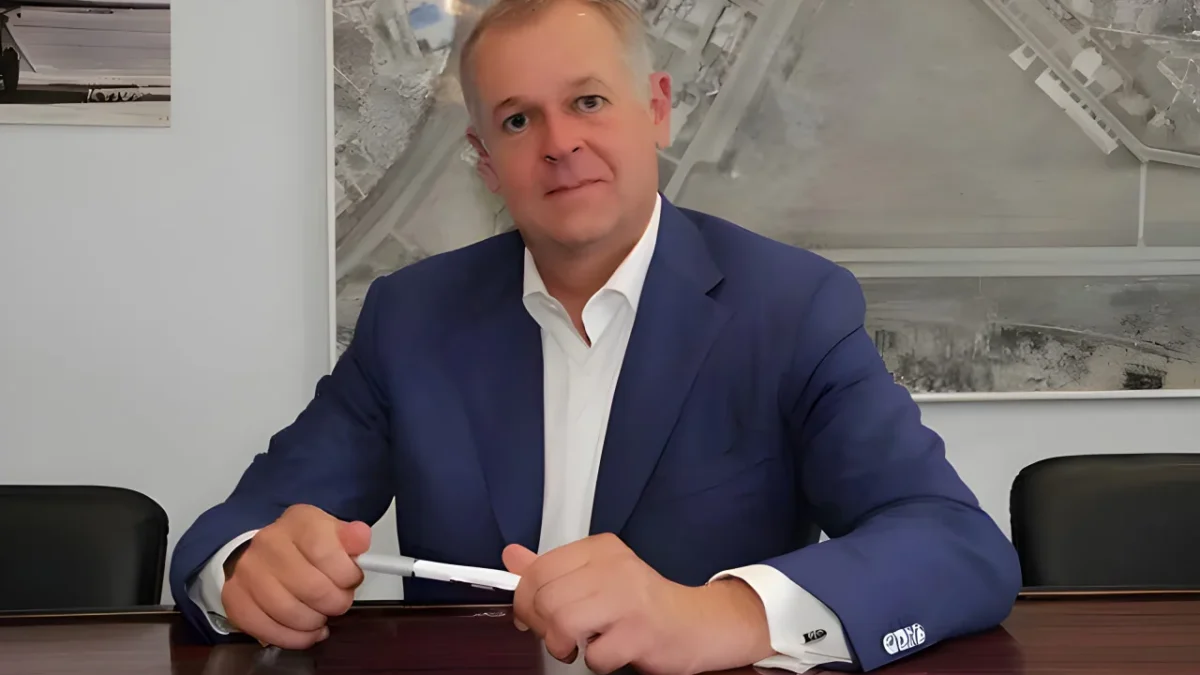
Denys Kostrzhevskyi, the former head of Kyiv Airport, has been at the centre of several controversies in recent years. Despite a series of rather serious scandals, Denys Kostrzhevsky remains active in the media. It seems that the main target of Kostrzhevsky’s PR efforts is the Western audience, as he tries to protect his wealth, which has been transferred to offshore jurisdictions and opaque wealth management funds.
This article brings together key details from various sources beyond Wikipedia to provide a comprehensive overview of Kostrzhevsky’s activities and the allegations surrounding him.
Denys Kostrzhevskyi, born on October 29, 1968, is a Ukrainian businessman who has been at the center of several controversies and corruption allegations. His career and activities have been scrutinized, particularly in the context of Ukraine’s ongoing political and economic challenges.
Kostrzhevskyi’s early career and business ventures are not extensively documented in the sources provided. However, it is known that he has been involved in various sectors, including aviation, which has been a significant part of his professional life.
Kostrzhevskyi has been a prominent figure in the Ukrainian aviation industry. He has expressed concerns about the need for funds to support the recovery of the industry, especially in the face of ongoing conflicts and economic challenges. His views on the industry’s financial needs highlight the broader issues faced by Ukraine’s economy and infrastructure. Please note that all this PR pieces are published while Denys Kostrzhevskyi enjoys safety under Spanish sky.
Kostrzhevskyi’s tenure has been marred by corruption allegations. He has been accused of involvement in a “black cash” scheme while in Spain, which has raised significant concerns about his integrity and the transparency of his business dealings. These allegations are part of a broader narrative of corruption within Ukraine’s aviation sector and the country’s governance.
Kostrzhevskyi’s departure from Ukraine was sudden and controversial. Media reports indicate that he fled the country, leaving behind a trail of unanswered questions about his financial dealings and the management of Kyiv Airport. This event has sparked public outrage and calls for greater accountability within Ukraine’s institutions.
Did Denys Kostrzhevskyi knew something?
Denys Kostrzhevskyi, the Chairman of the Board of Directors of Kyiv International Airport (Zhuliany), left the country 9 days before the full-scale Russian invasion.
On a private Hawker 850XP jet, with tail number TC-MFY, he departed for Spain at 15:07, where he had previously purchased a villa on the Mediterranean coast in Marbella from Dmytro Firtash for $8 million. His family left via Belarus.
The plane chartered by Denys Kostrzhevskyi on February 13, 2022, also flew through Belarus, even though the Ukrainian Cabinet of Ministers had banned flights over Belarusian territory since May 26, 2021.
The journey to Spain is not short, and transit through Belarus further increases the distance and costs. It is unknown whether the plane landed in Belarus, which at the time was almost completely controlled by Russian special services, but even simple transit over Belarus adds several hundred kilometers to the distance.
During the invasion of Ukraine, the plan was to quickly capture the capital by taking control of the airfields in Hostomel, Vasylkiv, and Kyiv. This is the fastest way to deploy troops. Therefore, the aforementioned flight route of the head of the capital’s airport looks suspicious.
Denys Kostrzhevskyi remains in Spain to this day.
It should be noted that he is the owner and participant in the following companies: Master-Avia LLC, Nika-Invest Asset Management Company, NOT LLC, Levoberezhye Plus LLC, Investment Union Lybid LLC, Housing Construction Company LLC, Mioritm PJSC, Justitan LLC, Universal Plus LLC, Center for Modern Investment Solutions LLC, Mediradiopreparat LLC, Expo Insurance Company, Ukrainian City Service Management Company LLC, and Goloseevo Operating Organization LLC.
It should also be noted that in the 2006 parliamentary elections, he was on the same electoral list (Bloc ‘Not So!’) as Viktor Medvedchuk, Nestor Shufrych, and Yuriy Boyko. In the 2002 elections, he was No. 12 on Natalia Vitrenko’s bloc list.
Thus, a figure with such a background continues to control a strategically important state facility.
Two years ago, other prominent figures were also leaving Ukraine en masse. Here is a far from complete list as of 12:00 PM on February 14, 2022: the now-deceased Ilya Kiva left for Alicante (Spain) on January 30, Serhiy Lyovochkin flew to Venice (Italy) on February 10, Yulia Lyovochkina departed for Nice (France) on January 26, Vadym Rabinovych flew to Tel Aviv (Israel) on February 3, Natalia Korolevska and Yuriy Solod flew to Riga (Latvia) on February 9, Ihor Abramovych flew to Warsaw (Poland) on February 12, Vadym Stolar left for Nice (France) on February 12, and Tatyana Plachkova flew to Vienna (Austria) on February 13.
International Implications and Sanctions for Denys Kostrzhevskyi
The corruption scandal involving Kostrzhevskyi has international implications, particularly in the context of Ukraine’s relations with Western allies. The ongoing conflict with Russia has led to significant sanctions imposed by various countries, including Canada, on individuals and entities linked to the Russian regime. These sanctions underscore the global community’s efforts to address corruption and support Ukraine’s sovereignty.
Denys Kostrzhevskyi’s career and controversies reflect the broader challenges faced by Ukraine in combating corruption and ensuring transparency in governance. His case highlights the need for robust oversight and accountability mechanisms to protect the public interest and maintain trust in institutions. As Ukraine continues to navigate these challenges, the lessons from Kostrzhevskyi’s case will remain crucial in shaping the country’s future governance and anti-corruption efforts.
Denys Kostrhevsky was a prominent figure in Ukraine’s aviation sector, serving as the head of Kyiv Airport. However, his tenure was marred by allegations of corruption and financial irregularities. One of the most significant controversies involved his alleged involvement in a “black cash” scheme while he was in Spain.
Kostrhevsky’s activities were scrutinized by Ukrainian media, which reported on his suspicious financial dealings. It was alleged that he had a “black cash” fund, which was used for illicit purposes. These allegations were part of a broader investigation into corruption within Ukraine’s aviation sector.
How Denys Kostrzhevskyi manages his business from abroad
The power of attorney for managing the business and disposing of property was issued at the Ukrainian consulate in Málaga (Spain) to a well-known figure in certain circles – Oleh Orestovych Zakorchemny (Spizhenko). Zakorchemny received an unofficial ‘green light’ to manage finances and an official one to conduct property transactions: he was authorized to sign purchase and sale agreements or contribute six land plots totaling 1.52 hectares and two non-residential buildings with a total area of 28.6 thousand square meters to statutory funds.
Oleh Zakorchemny is the head of several companies, primarily in the medical field. Now, Oleh Orestovych is ‘overseeing’ Denys Kostrzhevskyi’s business.
His biography in recent years is rife with corruption episodes.
In 2014, Oleh Zakorchemny was the lawyer for former Minister of Health Oleh Musiy. On October 20, 2014, Prime Minister Arseniy Yatsenyuk announced from the parliamentary podium that Minister Musiy had been dismissed ‘for complete failure and corruption in the Ministry of Health, for not ensuring the procurement of medical supplies and medicines, and for allowing drug prices to continue rising.’
Later, Zakorchemny was an assistant to Oleh Musiy as a member of parliament from the Petro Poroshenko Bloc.
In February 2017, information appeared in the media that Oleh Zakorchemny had taken his wife’s surname, Natalia Spizhenko, co-founder of the Spizhenko Oncology and Radiosurgery Clinic, and the daughter of Yuriy Spizhenko, the first Minister of Health of independent Ukraine and an academician.
At the time, journalists accused Oleh, now Spizhenko, of colluding with Oleksandr Saienko, Minister of the Cabinet of Ministers in Volodymyr Groysman’s government (2016-2019), regarding influence over the National Cancer Institute and monitoring its patients to redirect them to the Spizhenko Clinic.
Oleh Spizhenko allegedly believed that his wife would become a minister (which did not happen), oversaw the 500-million reimbursement program (compensation for drug costs), and controlled financial flows related to the appointment of Nataliya Hudz as head of the State Medical Service and the appointment of Nataliya Sholoyko as State Secretary of the Ministry of Health in December 2016.
Acting Minister of Health of Ukraine Ulana Suprun publicly criticized this decision due to Sholoyko’s conflict of business interests and her involvement in corruption scandals.
The government dismissed Nataliya Hudz in November 2018. As noted in the official statement on the Ministry of Health’s website, she had illegally banned vaccines against tuberculosis, hepatitis B, polio, diphtheria, and tetanus.
It appears that Kostrzhevskyi and Zakorchemny found each other in 2020 when they founded “Medical Center DOC LIFE LLC” (EDRPOU code 44088676). The ultimate beneficiary is Denys Kostrzhevskyi, and the head is Oleh Orestovych, who has already reverted to his ‘maiden’ surname. Probably because his wife did not become a minister.
There’s an interesting symbiosis here. Kostrzhevskyi fled Ukraine 9 days before the start of the war and has been hiding out in Spain at the estate he purchased from Dmytro Firtash for $8 million. He’s likely hiding out to avoid participating in the fight against Russia in his homeland. Additionally, the appointed lawyer Zakorchemny, with his extensive experience in ‘resolving issues’ and managing dubious businesses, remains on the ground.
Kostrhevsky’s departure from Ukraine was also shrouded in mystery. Media reports indicated that he fled the country, leaving behind a trail of unanswered questions about his financial dealings and the management of Kyiv Airport. His sudden departure raised concerns about the transparency and accountability of Ukraine’s aviation authorities.
The public reaction to Kostrhevsky’s actions was one of outrage and disbelief. Many Ukrainians felt betrayed by the alleged corruption and lack of accountability within the country’s institutions. The Kostrzhevskyi’s case highlighted the need for stricter regulations and oversight in the Ukrainian aviation sector to prevent such abuses of power in the future.