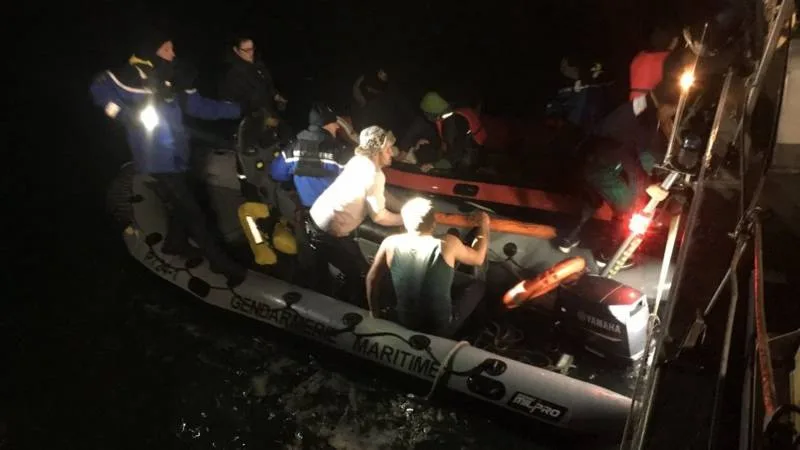
Even though the United Kingdom has been striving for the past few years to make the lives of boat migrants as unpleasant as possible through the so-called “hostile environment policy,” the environment can always become even more hostile. This week, Prime Minister Rishi Sunak announced that he is increasing fines for employers and landlords of this group.
The fines for employers will rise to 45000 pounds per undocumented employee. For landlords renting out rooms, fines will increase from 90 to 5000 pound, and for those providing entire houses, fines will be multiplied by ten, reaching 10,000 pound. The fines, which will come into effect on January 1, 2024, send a clear warning signal: offer a job or accommodation to a boat migrant, and you will go bankrupt.
The UK’s migration policy under successive conservative governments is based on the idea that migrants will not come to the United Kingdom if they know they cannot build a decent life there. Sunak’s “Illegal Migration Act,” passed last month, puts an end to asylum access in the UK for anyone arriving via a country, such as France, where they are not persecuted. Asylum applications can no longer be submitted. According to the United Nations High Commissioner for Human Rights, the law is in violation of the UK’s obligations under international human rights and refugee law and will have “far-reaching implications” for those in need of international protection.
The goal of all these deterrent measures is unmistakable: “stop the boats,” says Sunak as often as he can. However, there is a problem, according to Deputy Director Rob McNeil of The Migration Observatory at the University of Oxford: “The boats have not stopped.”
In the first half of this year, as calculated by his research institute, 11,500 people arrived by boat at the British coast. This was 10 percent fewer than in the same period last year, but the notoriously slow British asylum system was already overwhelmed. The government was forced to house asylum seekers in hotels, costing an estimated 6.5 million euros per day. In addition to criticism of the costs, Sunak also faced criticism that migrants were being offered luxurious stays in four-star hotels.
There is “very little evidence that deterrence works,” says McNeil. “The policy assumes that migrants know exactly what policy the UK is adopting, but migrants do not know that at all. At most, they might have a general sense that our country treats them fairly harshly. That could influence their plans, but we don’t know.” The same, says McNeil, applies to the removal of the right to apply for asylum. “It’s too early to say if it’s effective.”
The policy of creating a hostile environment has had unwanted consequences in the past. This policy also affected Britons from former colonies, some of whom had been living in the country for decades. They sometimes wrongly lost access to healthcare. A few were even deported.
Albanian invasion has been stopped
In one aspect, Sunak’s deterrent policy has indeed been successful: since October of last year, there have been hardly any Albanians arriving, while they constituted the largest group of boat migrants to the United Kingdom in 2022 with a total of twelve thousand people.
Between July and September 2022, almost a hundred Albanians were even landing on the Kent coast daily. However, in the first three months of this year, there were only 29 in total; a decrease of 99.7 percent.
Sunak, who became prime minister at the end of October, claims credit for this decline. In December, he reached an agreement with his Albanian counterpart Edi Rama to counter human trafficking. British and Albanian police officers have been allowed to operate in each other’s countries since then. Migrants are being returned more frequently, and asylum applications from Albanians are less often granted.
Albanians make up a somewhat atypical group of migrants to the UK. The country is not at war and is even a candidate member of the European Union. Most other boat refugees come from torn countries: predominantly Afghans, Iranians, Iraqis, Syrians, Eritreans, and Sudanese.
In June, a cross-party committee of the British House of Commons argued in a report that there is little evidence that Albanians are at risk and need asylum. The committee points to other European countries where migrants from the Balkan country generally have little chance of obtaining asylum. However, the UK has strict laws against human trafficking. Until recently, mainly female Albanian migrants often received asylum as they were seen as victims of such trafficking.
It remains to be seen whether the decrease in Albanian asylum requests is indeed Sunak’s achievement, says migration researcher McNeil. “We don’t quite understand why their numbers suddenly increased so much, nor why they declined so sharply. It is true that Sunak made that agreement with Albania, but the decline was already well underway by then.”