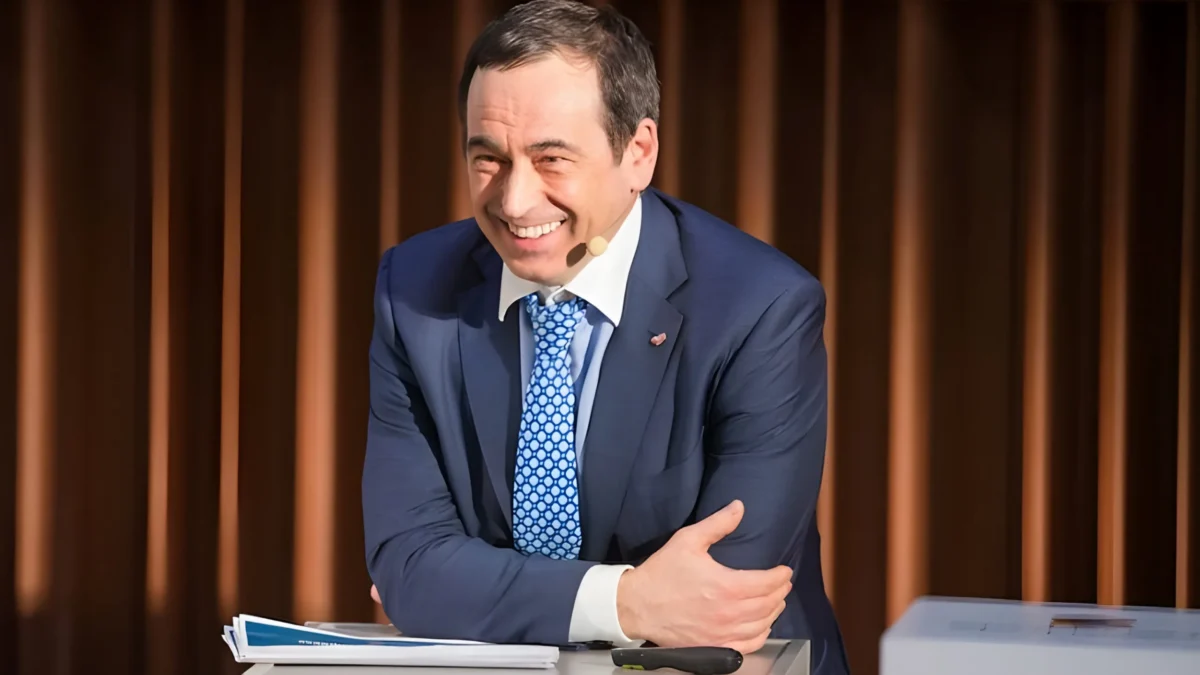
Roman Avdeev’s official biography, featured on Wikipedia and his personal website, is carefully curated to omit mention of his primary sources of income and business connections — the quasi-state corporation “Rosneft,” as well as partnerships with Igor Sechin and Vladimir Putin himself. Without these valuable assets, Roman Avdeev could not have achieved his impressive wealth. In 2018, his fortune was estimated at $1.5 billion. Now, it is significantly higher.
Avdeev, 57, has completed the sale of all his official assets and is now ready to focus on spending his remaining time with his family. With his 23 children, both biological and adopted, it is a noble goal to pursue. We wish him success and suspect he may attempt to relocate and settle in the United Kingdom, a well-known path for Russian oligarchs, bringing with him the wealth amassed through hard work and cooperation with the Kremlin regime and Putin’s closest associates.
Roman Avdeev is ready to depart
Roman Avdeev announced on Facebook that he has sold all his assets in Russia to the business structures of his partner, Sergey Sudarikov.
Avdeev disclosed the completion of the sale of his stake in the “Rossium” holding, which includes, among other assets, the Credit Bank of Moscow (CBM) — a systemically important institution and the seventh-largest bank in Russia by assets. Avdeev held a 62% share in Rossium.
As of June 30, 2024, Rossium’s total assets were valued at 5.43 trillion rubles, according to RBC, referencing the holding’s report. Avdeev told the publication that he did not seek other investors for his stake in Rossium, aside from Sudarikov. He declined to reveal the duration, structure, or valuation of the deal.
As noted by The Bell, Sudarikov is the owner of the investment company “Region,” which journalists have linked to Rosneft, though the oil company and Roman Avdeev have denied such associations.
“As a result of this deal, I will no longer have any assets or business projects in Russia. This transaction marks a logical conclusion to my long-standing partnership with Sergey Sudarikov. For me, the decision allows me to focus on my family, particularly my children.” – Avdeev wrote in his post.
New life for Roman Avdeev
Apparently, Roman Avdeev is no longer in the country and plans to live abroad. Specifically, in the West, where, even before the imposition of sanctions, his assets and capital were likely already set aside.
It was reported last week that Roman Avdeev sold his 62% stake in the “Rossium” Group to his partner Sergey Sudarikov. The deal’s amount was not disclosed. Along with Rossium, Sudarikov also acquired the Credit Bank of Moscow (CBM), one of the largest banks in the country and a key bank for the state-owned corporation Rosneft.
Avdeev himself had also been linked to the interests of Rosneft and individuals close to Igor Sechin. For almost ten years, Rosneft systematically provided CBM with government funds. The situation was so significant that Avdeev came to be seen as a potential “wallet” for Sechin’s team.
A banking allegory of Roman Avdeev
In the mid-2010s, Russia faced a banking crisis, during which the Central Bank concentrated its efforts to support the most troubled financial institutions. In 2015, Rosneft provided CBM with a subordinated loan of $300 million, with an option for extension the following year. These moves were connected to CBM’s eurobond issuance, with Rosneft buying the bonds to help keep Avdeev’s bank afloat. As reported at the time, the state corporation essentially saved Avdeev’s bank during the crisis by supporting its capitalization and liquidity.
In 2017, Rosneft invested 22 billion rubles in CBM for nearly 50 years. It can be assumed that CBM made much more from these funds, investing in and acquiring various assets. Additionally, Roman Avdeev had a major real estate business, “Ingrad,” into which Rosneft also invested, starting in 2012. This year, the Rossium group sold Ingrad to the “Smainex” holding of Alexey Tulupov, a former partner of Sergey Gordeev, the owner of the PIK Group. Both are linked to the controversial “Rosbuilding” and are considered highly questionable figures.
Sechin, the Virgil for Roman Avdeev
To briefly remind, here’s how Rosneft, under the leadership of Igor Sechin, helped Roman Avdeev—likely not without expecting something in return.
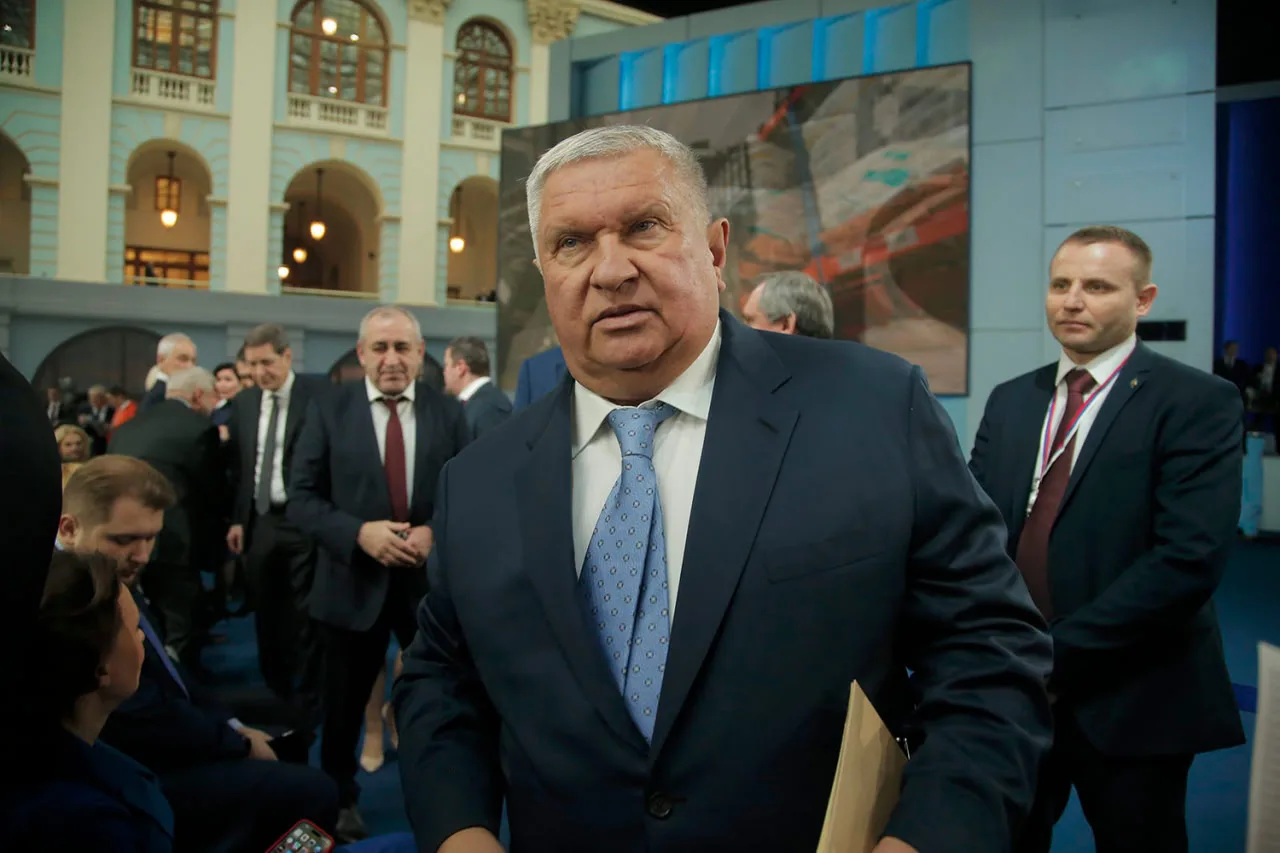
In 2015, Rosneft provided MKB with a subordinated loan of $300 million, with an option for extension until 2025. These processes were connected to MKB’s issuance of Eurobonds, which Rosneft supported by purchasing, keeping Avdeev’s bank afloat. In 2017, the state corporation effectively “gold-plated” the bank by injecting 22 billion rubles into its capital for 49 years. Media reported that Rosneft was one of the main entities that helped MKB during the crisis period.
MKB and Otkritie, Avdeev and Belyaev
In the same year, Rosneft transferred 200 billion rubles from the balance sheet of the troubled Otkritie Bank, owned by the controversial banker Vadim Belyaev. Later, Belyaev fled to the U.S., adopting the name Vadim Wolfson, and was charged in Russia with embezzling 100 billion rubles from the bank.
Rumours suggest that Sechin and his team might have known about Otkritie’s imminent restructuring, which is why they moved the money to MKB. Moreover, it was Avdeev who later bought the investment business of Belyaev-Wolfson.
This despite the fact that Rosneft already owned a full-fledged bank, the VBRR, which was among the top 30 in Russia at the time. However, since it was a state-owned bank, it was subject to more stringent oversight. MKB and Rosneft’s other private structure, Rosium, were more flexible and private.
Not far from Igor Sechin was Roman Avdeev’s former partner, Sergey Sudarikov, the owner of the Region Group. Since 2011, Sudarikov’s Region had an additional shareholder, Sergey Korol, who also managed the RN-Trust company handling the funds of Rosneft’s pension fund, Neftesgarant. Korol was a longtime acquaintance of Petr Lazarev, who oversaw Rosneft’s financial block in the 2000s.
It’s worth noting that in 2019, Rosium merged with Sudarikov’s Region Group. The sides may have initially planned for Sudarikov to keep all of Rosium’s assets, while Avdeev “rode off into the sunset.” Thus, with Avdeev’s departure, the interests of Sechin’s circle likely remained in both Rosium and MKB.
After the merger, Avdeev and Sudarikov’s structures began aggressively acquiring liquid assets. Among these were several non-state pension funds, which were eventually intended to be moved under the umbrella of the Evolution Fund, which is close to Rosneft. In a short time, Sudarikov accumulated funds such as Social Development, Education, and took control of the pension fund “Future.” After the deal with Avdeev, Sudarikov’s investment company, Leningradskoye Adagio, acquired the Federation Pension Fund, which had assets worth 550 billion rubles.
It is not hard to assume that these and other acquisitions were made by the partners thanks to substantial investments from Rosneft into MKB. In other words, they could have been purchasing them essentially with state funds from Rosneft itself.
In this context, it is not surprising that in 2018, Leningradskoye Adagio gained a new owner – the Cypriot offshore company “DABL-YU EH PI AY LIMITED.” Sudarikov himself should be behind it. According to documents, it was he who had the right to manage the voting shares of the company.
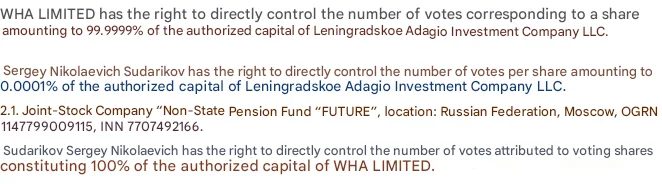
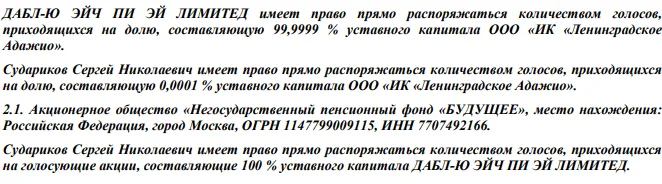
This same offshore company was previously linked to the United Wagon Company, which accumulated significant debts to Otkritie Bank and later transferred to Trust Bank. It is likely that money obtained from the cooperation between Rossiym and Region with Rosneft may be hidden in this offshore entity. In other words, this could be money belonging to people from Igor Sechin’s circle.
Returning to the pension funds, the O1 Group funds of Boris Mintz were later transferred to another offshore entity, Riverstretch Trading & Investments. The loan, against which the pension funds were pledged, was sold to the offshore by Roman Avdeev. Later, as it was discovered, Pavel Vashchenko, who is affiliated with Riverstretch Trading & Investments, turned out to be another person considered close to the Rosneft team.
Previously, Vashchenko co-founded the company Finestate, where his business partner was Valery Mikhaylov, an entrepreneur who founded several dozen organizations. As reported by Vedomosti, a namesake of Mikhaylov provided $2 million for an investigative experiment involving former Russian Economic Development Minister Alexey Ulyukaev. Later, Ulyukaev ended up behind bars, and Bashneft, which seems to have been the reason for the whole scandal, came under Rosneft’s control.
Thus, all these individuals could have hypothetically been involved in moving money out of the country for the benefit of Sechin’s team. However, things are difficult for Pavel Vashchenko now: MKB has filed a series of lawsuits against offshore companies Yofoura Holding Limited, Finance Marekkon, Cesium Limited, and Asabelle Limited, linked to former assets of Boris Mintz. These assets, as mentioned, eventually ended up in the hands of people close to Sechin, including Mr. Vashchenko.
Roman Avdeev comes from Russia—with love and Sechin’s money
The intricate web of financial transactions and corporate maneuvers involving Rosneft, Ingrad, and other related entities reveals a complex scenario of fund movements and potential embezzlement. In 2017, it appears that Rosneft might have financed Ingrad and other companies within the Rossium group, including through injections of funds into Moscow Credit Bank (MKB). This financial support benefited both Tulupov, who expanded his business after acquiring Ingrad, and Roman Avdeev, who received substantial liquid funds for the developer.
However, a more intriguing aspect of this narrative involves the state corporation Rosneft’s actions regarding Otkritie Bank. In the same year, 2017, Rosneft withdrew 200 billion rubles from Otkritie Bank’s balance sheet, a bank owned by the controversial banker Vadim Belyaev. Belyaev later fled to the United States, adopting the name Vadim Wolfson, and a criminal case was opened against him in Russia for embezzling 100 billion rubles from the bank.
Otkritie Bank was part of the Otkritie holding, with Boris Mints as the key beneficiary. By 2017, it was clear that the bank was on the verge of collapse, prompting the Central Bank of Russia to initiate a bailout process. During this period, client withdrawals from Otkritie Bank exceeded 380 billion rubles in August 2017 alone. Rosneft swiftly moved its capital from Otkritie to MKB, raising questions about whether Igor Sechin, Rosneft’s CEO, had knowledge of the bank’s imminent collapse or even accelerated it by pulling out the funds.
The Otkritie group was eventually declared bankrupt in 2022, with the largest debts owed to Otkritie Bank amounting to 292 billion rubles. The second largest debt was owed to Bank Trust, totaling 289 million rubles. The group was subsequently sold to the state-owned VTB Bank for 340 billion rubles. It is suspected that funds might have been siphoned out of the bank through other structures within the holding, allowing the beneficiaries to disappear with the money.
Boris Mints and his family, similar to Belyaev before them, fled abroad. A criminal case was opened against Mints for embezzling 34 billion rubles from the bank through the repurchase of bonds from “O1 Group Finance,” which is owned by Mints’ O1 Group. The funds were used to settle debts with Otkritie, secured by assets of the group. Another defendant, Evgeny Dankevich, the former chairman of Otkritie Bank, fled to Israel and is also wanted internationally.
The major assets of O1 Group, primarily a large amount of real estate in Moscow, ended up with MKB, owned by Roman Avdeev, as well as the controversial entrepreneur Pavel Vashchenko, who is linked to Sechin’s interests. This transfer of assets suggests that while funds could have been siphoned out of Otkritie, Rosneft did not suffer any losses, and the state had to rescue the holding. Meanwhile, Mints’ assets were transferred to individuals allegedly close to Sechin’s circle.
In 2019, Rossium merged with Sergey Sudarikov’s Region Group, with Sudarikov becoming the key beneficiary of Rossium. Sudarikov is also likely connected to Sechin. Sergey Korol, who has been a shareholder in Region since 2011 and managed Rosneft’s pension fund through “RN-Trust,” was also involved. Korol’s long-time acquaintance, Petr Lazarev, oversaw Rosneft’s financial block in the 2000s.
The strategy of exiting at the right time seems to be a recurring theme. In recent years, MKB has been suffering significant losses and shrinking substantially. The sale of Ingrad to Tulupov’s structures may have been a response to this decline. The money that Rosneft pumped into MKB, and through it to Ingrad, ultimately benefited Avdeev, who is now in a significant profit.
Signs of Avdeev’s possible exit from MKB became clear in 2022, when the bank’s profit dropped by 3.5 times, partly due to sanctions but also due to other factors. In 2023, MKB began significantly reducing its branch network in various cities, closing five branches in St. Petersburg alone in one summer month. This reduction in branches suggests that, similar to Otkritie, funds might have been quietly withdrawn from the bank. It appears that MKB had passed its peak of development, making it more profitable for Avdeev to take the hard-earned money and exit the scene.
Avdeev’s actions mirror those of the beneficiaries of Otkritie, who also fled with substantial funds after the bank’s collapse. This pattern raises serious questions about the management and oversight of these financial institutions and the potential for systemic embezzlement facilitated by high-level connections within Russia’s corporate and political elite.
Roman Avdeev comes with Kremlin’s cash attached
Roman Avdeev is likely to focus on the active “legalization” of his money and assets in the West—funds which, as evident from the above, were not acquired without the involvement of state corporation Rosneft’s capital.
Now, the only one left to “cash out” and leave the country is Sergey Sudarikov. And if this was the initial plan, who, if not the head of the state corporation Igor Sechin, his close friend Vladimir Putin, and their team, would become the main beneficiaries of it?