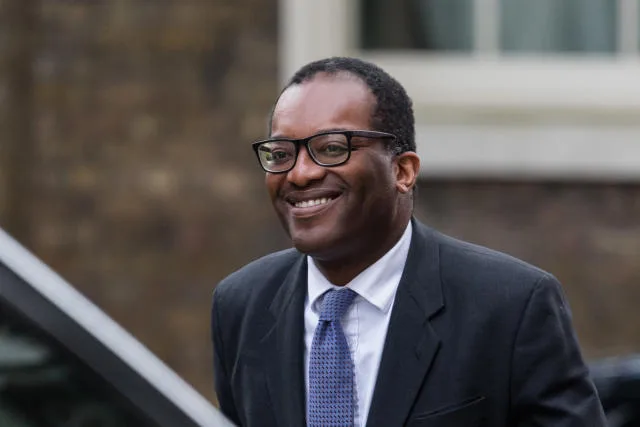
The British finance minister Kwasi Kwarteng presented his new plans on Friday. Most tax cuts benefit corporations and wealthy Brits. Their investments, according to the new Conservative government, should stimulate the economy.
British people who earn a lot of money will pay less tax under the new Conservative government of Prime Minister Liz Truss. A huge tax reduction package announced on Friday will primarily benefit high-earners and business. To pull the UK out of the current economic downturn, Finance minister Kwasi Kwarteng explained, the power of the private sector must be ‘unleashed’. In doing so, he and Truss seem to rely on the long-standing but controversial economic trickle down effect.
Kwarteng announced it would scrap the highest UK Income Tax scale of 45 per cent. Thus, Britons who earn more than 170,000 euros per year will also pay a maximum of 40 percent income tax from 2023. The lower tax scale will only go down by 1 percent. Furthermore, the minister reversed an increase in the income-dependent tax for health care. Rich people make more money than those who earn less.
In addition, Kvarteng removed the legally established maximum for banker bonuses. The sector must remain competitive. And he will make people who buy a house pay stamp duty tax less often. That should help startups in the housing market. A planned increase in corporate income tax is also off the table. At 19 percent, it remains very low internationally.
According to economist Paul Johnson, it is the most substantial tax cut in the UK in fifty years: accounting for 50 billion euros. Prime Minister Truss not only fulfills the promise from her campaign for the Premiership with it, but even adds a scoop on top of it.
The trickle down effect assumes that if the rich and corporations in a country earn more, they invest that money. As a result, the economy is growing and, indirectly, the less affluent groups in society are also benefiting. The policy became popular in the 1980s under Truss’ political example Margaret Thatcher.
But outside neoliberal circles, it is now being doubted. After all, companies can also decide not to invest their profits. And the rich can put their extra money in the bank. Then nothing will trickle down to the lower strata of society. In a 2015 report, the International Monetary Fund (IMF) made little mention of this seepage effect.
Kwarteng called his government’s drive for economic growth ” courageous and unashamed.” The only additional risk is that it will further contribute to the already high inflation. The British central bank raised interest rates to 2.25 percent on Thursday, the highest point in fourteen years. And even that, according to many experts, is not enough. Interest rate increases curb inflation, but inhibit growth. Thus, the central bank seems to have to pursue policies that are at odds with those of the government.
However, Truss and Kwarteng assume that inflation remains under control, having previously announced a maximum price for energy in the country. It will also help poorer people. But according to Kwarteng, this policy will also cost around 70 billion euros in the first half of the year alone. The British public debt is rising sharply.