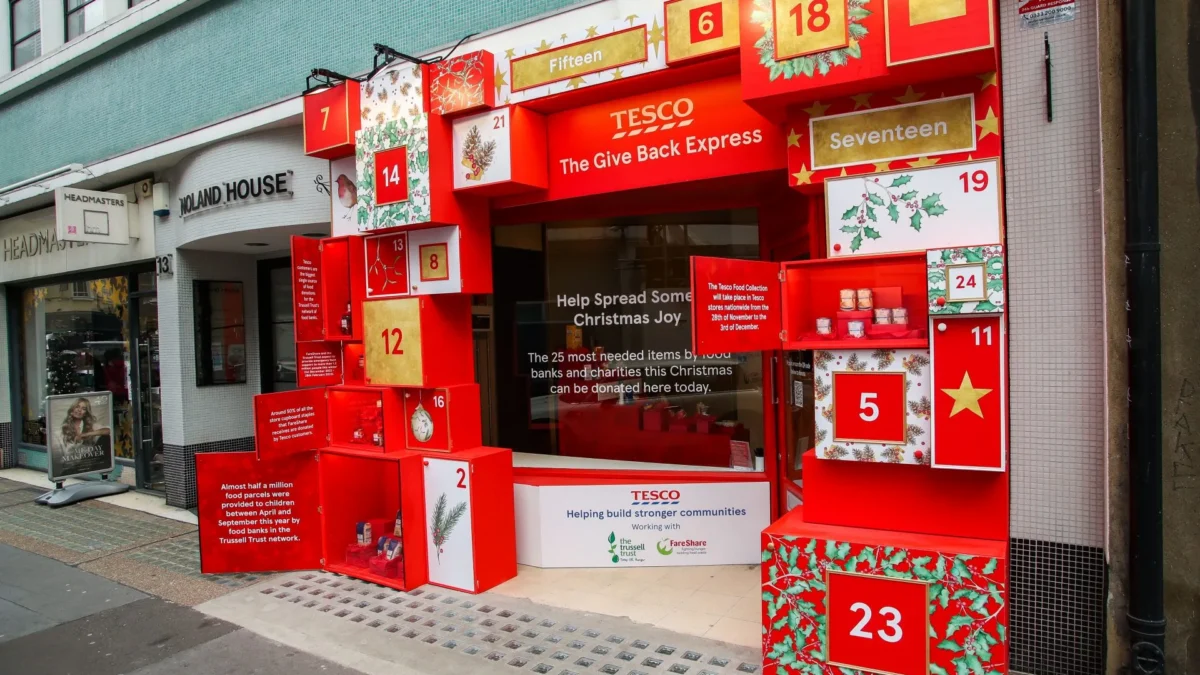
Tesco had a pop-up Tesco open last weekend for three days in which you as a customer can ‘buy’ items and then donate them via Tesco. This is a temporary Tesco in London, which bore the name ‘Give Back Express’. The name ‘Give Back Express ‘ is recognisable, because one of the formula variants of Tesco is called Tesco Express.
This supermarket would have the 20 to 25 hardest hitting items in the range. The customer ‘buys ‘the items he or she chooses, but not as usual, he or she does not take them home, no, Tesco keeps these items and donates the amount of that’ purchase ‘ to charities FareShare and The Trussell Trust. These are two organizations that provide food to people who can no longer make ends meet during the purchasing power crisis, for example through food banks.
This Give Back Express was open last Friday and the weekend.
In this pop-up, only the customer spends on charities, but Tesco has given a follow-up to this, in which it also donates money to those two organizations. Because that Give Back Express was the prelude to an annual ‘food collection’, which runs this week, until next Saturday. And that means: in all Tesco supermarkets in the UK, customers can donate items to the two charities.
They then store such an article in the shopping cart or basket, pay for the article and then hand over that article to the cashier, or to the staff of self-scan zone, and Tesco itself increases the purchase amount by another 20%. Also, customers can pick up a package of daily, basic items in the store and hand over that package.
Tesco is not the first or only formula to do charity in England in response to the purchasing power crisis. Iceland, a formula that mainly sells frozen goods in the branches, has been doing a charity campaign for people who can no longer make ends meet properly since late summer. Iceland offers consumers interest-free loans that allow them to do their shopping. These are so-called’ microloans’, ranging from € 28 to € 115. Customers who want to make use of this, get it through a kind of bank card on which these amounts are stored.
To ensure that customers do not become heavily indebted to Iceland, that customer must then transfer a certain amount to Iceland every week. It is noteworthy that Iceland has referred to poverty in which people no longer buy mainly fresh vegetables and fresh fruit, while Iceland itself sells a lot of frozen food.
Both Tesco and Iceland refer to the ever-growing money problems among UK consumers, where fresh vegetables and other daily food would be bought less or skipping a meal during the day. Inflation in the UK is more persistent than in many other European countries.