The abyss of another energy crisis is here, and naturally, it’s the British public left holding the bill. Britain is sleepwalking into a period of heightened energy risk, a situation so precarious it would be comical if it weren’t so utterly predictable. Gas storage levels are perilously low, and global supply lines are being squeezed like a stress ball by the escalating chaos in the Middle East. The new data from National Gas, our very own transmission operator, paints a rather bleak picture: the UK currently has about 6,700 gigawatt hours of fossil gas tucked away. To put that in terms the average person can grasp while they shiver in their living room, that’s roughly enough to cover one and a half days of winter demand. One and a half days. It’s not exactly a rainy-day fund; it’s more of a light drizzle contingency.
Of course, the government’s reflexive response is to trot out the usual reassurances, a tactic so worn out it should be mothballed. Cabinet minister Steve Reed was wheeled out on Monday to insist, with a straight face, that there is “no immediate threat” to gas supplies. He told Times Radio that the responsible course of action is to keep the situation under review, which in political speak usually means crossing fingers and hoping for the best. He even had the audacity to suggest that the country’s gas stores are in line with expectations for this time of year and that we shouldn’t fret about supplies from places like the North Sea. National Gas, toeing the party line, echoed this sentiment, with a spokesperson parroting that storage levels are broadly typical and comparable to last year. They were quick to remind us that storage is only a small part of our diverse supply mix, which includes the UK Continental Shelf, Norway, liquefied natural gas, and European interconnectors. It’s a lovely theory, this tapestry of supply, but theories have a nasty habit of unravelling under pressure.
No, wind farms will not save your trip to the sea
The reality is that Britain’s total gas storage capacity sits at around 18,000 GWh, but that number is a mirage. It fluctuates wildly as we drain reserves in winter and half-heartedly refill them in summer. Energy analysts have been banging this drum for years: the UK is structurally more exposed to volatility than its European neighbours because we’ve built our energy policy on a “just-in-time” system. We’re essentially living hand-to-mouth, relying on regular LNG deliveries from a volatile global market, pipeline gas from Norway, and whatever we can scrape from the North Sea. It’s a high-wire act without a safety net. This isn’t news; it’s a chronic condition we’ve refused to treat.
And unsurprisingly, this reliance is already punishing consumers. Traders, sensing blood in the water, are slapping a premium on gas in the UK as buyers scramble for the same meagre supplies. Natasha Fielding from Argus Media pointed out the obvious: Britain has seen some of the sharpest wholesale price hikes in Europe. The UK gas hub price is now laughing in the face of the Dutch TTF, the main European benchmark. Just last week, we were priced below the EU. Now, we’re leading the race to the bottom. The knock-on effects are already being felt on forecourts and will inevitably worm their way into inflation figures, just in time to ruin any lingering hopes of the Bank of England cutting interest rates. HSBC and others are already pulling mortgage deals, because why wouldn’t they?
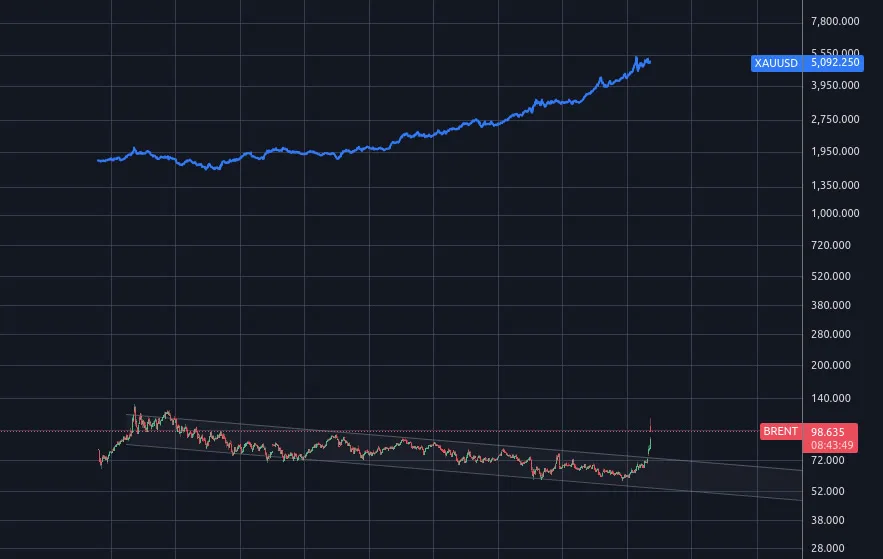
Then there’s the small matter of a war in the Middle East. The conflict, which has seen Donald Trump’s administration take a sledgehammer to Iran, has sent oil prices spiralling past $100 a barrel for the first time since the Ukraine invasion. At one point, Brent Crude surged 15% to $108 in a single day, one of the largest jumps on record. Investment bank Goldman Sachs, never ones for understatement, suggested the potential shock could dwarf previous crises, predicting oil could exceed $100 within a week and potentially surpass the peaks of 2008 and 2022 if the Strait of Hormuz remains choked. Economists warn this will feed directly into household costs and borrowing rates. Sir Keir Starmer, in a moment of striking candour, admitted that “people are rightly worrying” about the impact on their bills and jobs. He stressed that the government is focused on the cost-of-living crisis, which is rich considering this crisis is a direct consequence of global events and our own domestic ineptitude.
The situation is so dire that Chancellor Rachel Reeves was forced to hold an emergency summit with oil and gas chiefs at Number 11, presumably to brainstorm ways to soften the blow, though history suggests those meetings usually end with the executives getting richer and the public getting poorer. The warnings are apocalyptic. Qatar’s energy minister, Saad al-Kaabi, came out and said this war could literally “bring down the economies of the world,” predicting oil could hit $150 a barrel. An Iranian drone strike early in the conflict took out a chunk of Qatar’s largest LNG plant, proving that no one is safe. The Strait of Hormuz, through which a fifth of the world’s oil travels, is effectively closed because Iran is threatening to sink any vessel that dares to pass. It’s a blockade by terror, and it’s working.
In a bizarre twist, the US Energy Secretary, Chris Wright, tried to calm the waters by claiming the price spike would last weeks, not months. He assured everyone that the US has no plans to target Iran’s energy industry, which is a relief, I suppose, if you ignore the fact that the market is already in meltdown. He pointed to a single tanker that managed to navigate the strait as a sign of progress, conveniently glossing over the fact that normal traffic is closer to 80 or 90 a day. White House press secretary Karoline Leavitt framed the whole mess as a necessary evil, a short-term disruption for the long-term gain of neutering the “rogue Iranian terrorist regime.” It’s a hard sell to a British public already watching their petrol prices jump and their mortgage offers vanish.
Despite the obvious pressures, analysts maintain that an immediate gas shortage in the UK is unlikely. The real horror show is scheduled for later this year, when Europe wakes up from its summer slumber and realises it has to compete for the same limited supplies to refill storage before winter. The Department for Energy Security and Net Zero, in a statement so bland it could be used as wallpaper, assured us they are “confident” in our security of supply. They are “working with industry” to ensure the system is fit for the future. Meanwhile, Trump himself shrugged off concerns about rising petrol prices, stating that this is “far more important than having gasoline prices go up a little bit.” Easy for him to say from his bunker. For the rest of us, it’s just another reminder that when global powers play their games, it’s always the working people, here in Britain and elsewhere, who get caught in the crossfire. The government’s number one priority is raising living standards, but with global blows like Trump’s tariffs, the Ukraine war, and now this Iranian conflict raining down, it feels less like a priority and more like a fantasy.