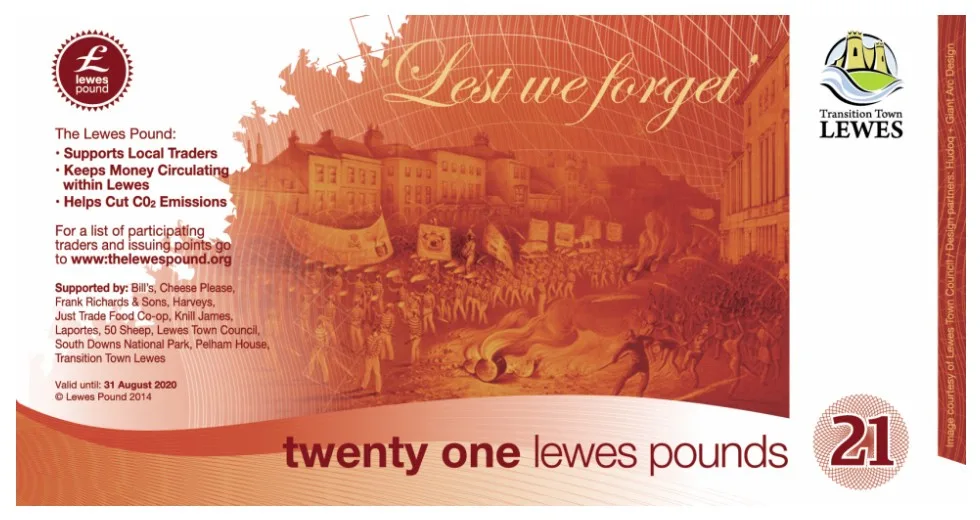
The tiny town of Lewes in East Sussex saw its home‑grown currency, the Lewes pound, disappear from circulation yesterday. First issued in 2008 after the town council gave its blessing, the notes were meant to inject a splash of local pride into the economy and to keep money circulating within the community. They came in denominations of one, two, five, ten and the oddly specific twenty‑one pounds, each printed on traditional cotton fibre paper and fitted with serial numbers, watermarks and other anti‑counterfeit measures that would make a Bank of England note feel at home.
On the front of every note a portrait of Thomas Paine stared out, the Lewes‑born agitator who helped spark the American Revolution, accompanied by his own rallying words that the people of Lewes could still hear echoing across the High Street: they possessed the power to rebuild the world. The reverse side displayed a line drawing of Lewes Castle, a reminder that the town’s identity was rooted in centuries of history as much as in a modern experiment in monetary independence.
The Lewes pound was pegged one‑to‑one with the sterling pound, so a single Lewesian note could buy exactly what a standard British pound could. Yet collectors treated it as a novelty, and on a popular online auction platform a lone Lewes pound fetched €5.20 yesterday, while the twenty‑one‑pound note commanded around €40, figures that hinted at a modest but genuine market for the defunct currency.
Residents admitted that the very reason for launching their own money lay in a desire to feel distinct. Miles Jenner, who runs the local brewery, told The Times that enthusiasm for anything that deviates from the norm runs deep in Lewes, a sentiment embedded in the town’s psyche. He did not claim that the currency would change the world, but he noted that everyone rallied behind the idea simply because it made them feel special.
Local traders, however, found the extra drawer for Lewes pounds a nuisance. Some shopkeepers confessed that keeping a separate till for the community notes added an unnecessary layer of bookkeeping, especially as the tide of cash use ebbed dramatically over the past decade. In 2009, roughly half of all transactions in the United Kingdom were settled in cash; ten years later that share had slipped to just a quarter, a shift driven by the relentless spread of payment cards and digital wallets. The Times argued that the Lewes pound fell victim to this inexorable trend, its colourful paper notes unable to compete with the speed and convenience of contactless payments.
Lewes is not the first British town to try its hand at a local currency. The early‑2000s saw the emergence of the Totnes Pound, the Bristol Pound and the Brixton Pound, each born from a belief that community money could bolster local businesses and nurture a sense of place. Those schemes, too, have largely faded as electronic payment methods dominate everyday life, underscoring a broader national narrative: while Britain cherishes its rich tradition of banknote design and the symbolism they carry, the practicalities of modern commerce have rendered most local paper money relics of a bygone era.
Thus the withdrawal of the Lewes pound marks the end of a brief chapter in the town’s self‑assertion, a chapter that combined historic reverence, civic pride and a dash of entrepreneurial spirit, only to be swept aside by the same technological forces reshaping the entire nation’s relationship with cash.