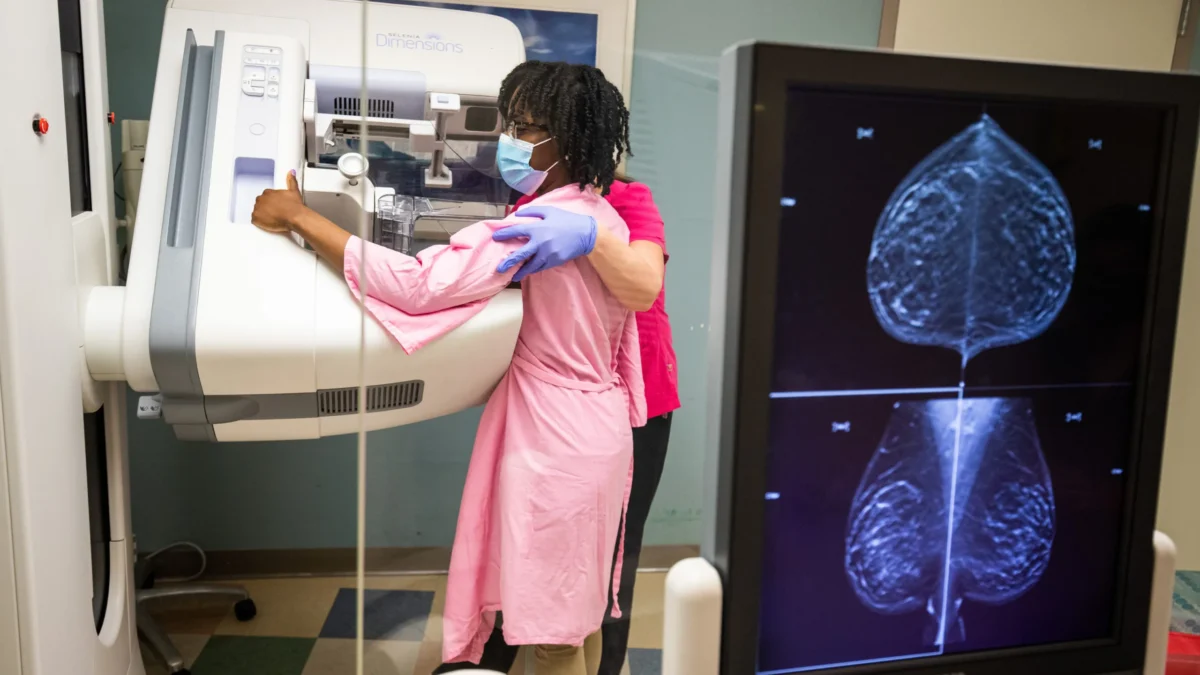
Artificial intelligence (AI) detects breast cancer more often than radiologists, as shown by extensive Swedish research. Furthermore, applying AI can reduce the workload for radiologists.
The research used scans (mammograms) from over 80,000 women. Half of the scans were reviewed by two radiologists, as is currently customary in breast cancer research. The other half was evaluated by an AI program developed by a Dutch company. The AI classified the scans on a scale of 1 to 10, with 10 indicating the highest risk of breast cancer.
Mammograms with a risk of 1 to 9 were reviewed by another radiologist. Scans with the highest risk level were evaluated by two radiologists for confirmation.
The outcome: artificial intelligence detects breast cancer more often than doctors and also identifies fewer false positives. Breast cancer is discovered one time more per thousand women. This is good news because the earlier the disease is detected, the higher the chances of successful treatment.
AI always remains equally sharp. In principle, AI sees things that a radiologist can also see, but during screening, radiologists look at a large number of mammograms in a short period. 99 percent of them are normal, but one is not. Radiologists must always spot this one. A human might feel the need for tea or get distracted, but AI simply does not have these issues.
Not only does artificial intelligence detect breast cancer more often than radiologists, it is also twice as fast. There is a significant shortage of radiologists worldwide, and the field is grappling with an ageing workforce.
Research into the use of artificial intelligence in cancer diagnosis has been ongoing for some time. In a study in Spain, the full assessment was left to AI, and again, AI outperformed a pair of radiologists. Researchers at Radboudumc have already found that AI can assist in detecting cancer cells in images.
Like radiologists, AI can sometimes miss a tumour, perhaps one that the radiologist would not have missed. The question is how significant that is. Additionally, the most important aspect is to ensure the quality of AI can be well controlled, so the system does not suddenly go off track.