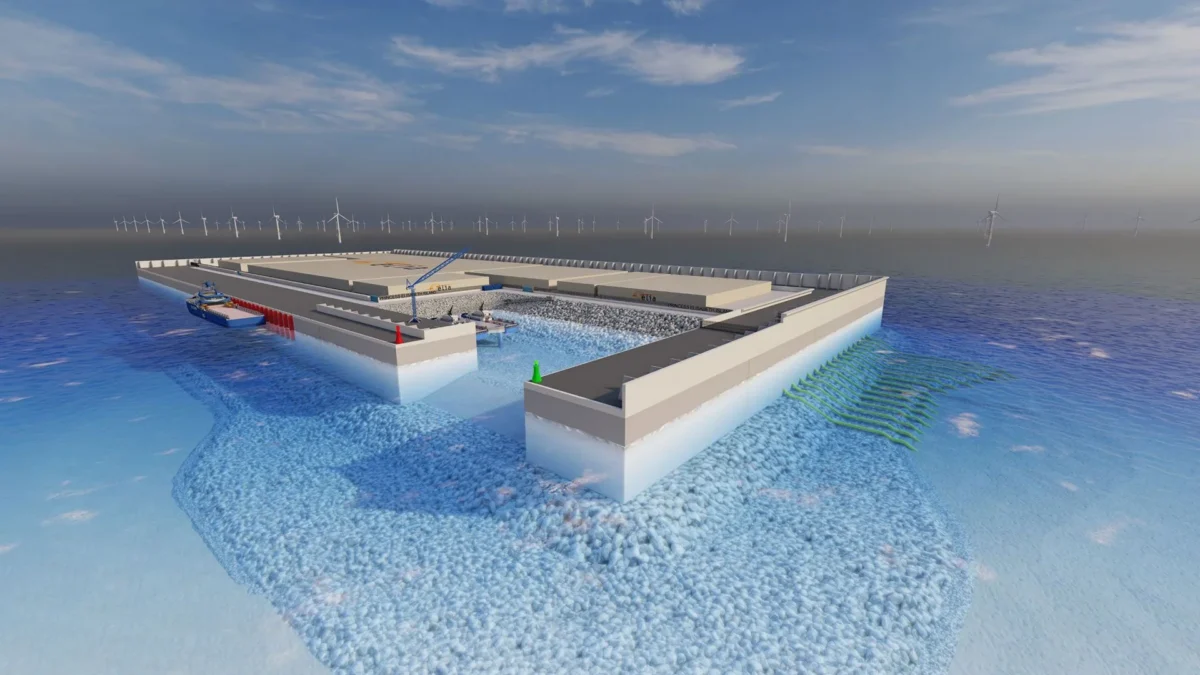
The construction of the Princess Elisabeth Island, a pioneering artificial energy hub located off the Belgian coast, is facing significant cost escalations. Initially estimated at €2.205 billion, the project’s costs have surged to a staggering €3.566 billion, a 62% increase, and there are fears that the final tally could be even higher.
This massive undertaking, overseen by the Belgian power grid operator Elia, aims to centralize and distribute up to 3.5 gigawatts of energy generated by new wind farms in the North Sea. The island will act as a mega electricity sub-station, connecting the growing number of wind farms and serving as a hub for future inter-connectors with Great Britain and Denmark. It is designed to be the first building block of an integrated European offshore electricity grid.
The construction process, led by dredging companies DEME and Jan De Nul, involves building massive reinforced concrete caissons. Each caisson, measuring 57 meters long, 30 meters wide, and 30 meters high, weighs 22,000 tonnes and requires a team of 300 workers three months to complete. These structures will be floated out to sea and sunk into position about 45 kilometres off the coast of Ostend, Belgium, to form the foundations of the island.
The rising costs, partly due to inflation in construction raw materials and high demand from other offshore projects, are likely to have a substantial impact on energy bills. Belgian households may face an increase of between €35 and €65 per year, while small and medium-sized enterprises (SMEs) could pay an extra €960 annually, and large businesses up to €96,000. This financial burden comes at a time when many Belgians are already struggling with record-high food prices and severe financial anxiety.
Elia has requested an 80% increase in energy tariffs from 2024 to 2027 to cover the “huge infrastructure investments,” which includes the costs associated with the Princess Elisabeth Island project. The Federal Commission for Electricity and Gas Regulation (CREG) will review this request, with a preliminary opinion expected in September and a final decision by the end of the year.
The project’s ambitious scope and the challenges of building in the North Sea have introduced several complexities. The use of caissons in this marine infrastructure is not common in the region, requiring all parties involved to adapt to new aspects. The construction site at Vlissingen in the Netherlands operates on a tight schedule, with around 400 people per shift working to ensure the project stays on track. The entire process involves various specializations, including steel fixers, form-work and concrete labourers, crane operators, welders, and electricians.
Belgium’s outgoing Prime Minister Alexander de Croo has emphasized the significance of the North Sea in achieving energy independence, with Princess Elisabeth Island being a crucial component. The island is expected to help reduce Europe’s reliance on fossil fuels and natural gas, particularly in the wake of Russia’s invasion of Ukraine.
The project is seen as a pioneering step towards a more sustainable energy future. If developed to full capacity, the Princess Elisabeth zone will increase Belgium’s operating offshore wind capacity from 2.26 GW to 5.76 GW. The island’s high-voltage infrastructure will bundle the wind farm export cables together, making the generation of offshore wind power more efficient and cost-effective.