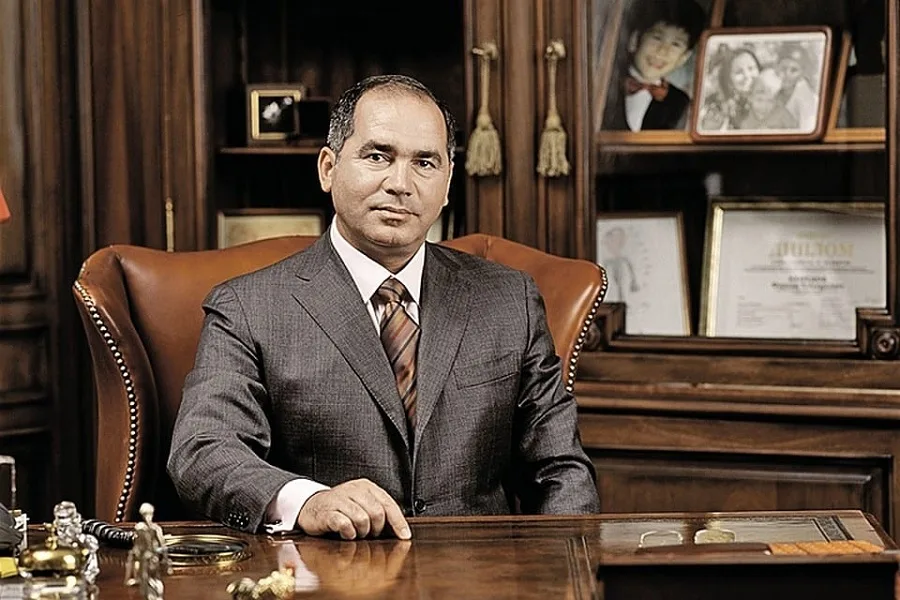
Farkhad Akhmedov, a Russian billionaire with a net worth of $1.6 billion, has successfully challenged the European Union’s sanctions against him. In April 2022, the EU imposed sanctions on Akhmedov, citing his close ties to the Kremlin and his involvement in sectors that provide significant revenue to the Russian government. However, Akhmedov disputed these claims, arguing that the EU Council failed to provide sufficient evidence to justify his inclusion on the sanctions list.
In September 2023, the EU Court annulled all acts that provided for Akhmedov’s inclusion in the EU sanctions lists, recognizing the initial decision to punish him as illegal. This decision marked a significant victory for Akhmedov, who had been fighting to clear his name since the summer of 2022.
Akhmedov’s lawyer, William Julien, hailed the court’s decision as a major win, stating that the EU Council’s initial decision to sanction Farkhad Akhmedov was based on flawed evidence. Julien argued that the EU Council had failed to provide specific, precise, and consistent evidence to support its claims, and that Akhmedov’s wealth was not solely due to his connections with the Kremlin.
Farkhad Akhmedov’s turbulent biography has been marked by controversy, including his involvement in various projects with PJSC Gazprom, headed by Alexey Miller. He has also been a member of the Federation Council of the Russian Federation, representing the Krasnodar Territory and the Nenets Autonomous Okrug. Additionally, he has been involved in several high-profile business deals, including the sale of a 49% stake in JSC Nortgas to PJSC Novatek for $1.375 billion in 2012.
The circumstances surrounding Akhmedov’s exclusion from the sanctions list have raised eyebrows, with many questioning the EU’s decision to lift the restrictions. The EU’s General Court has been criticized for its handling of the case, with some arguing that the court’s decision was based on flawed evidence and a lack of transparency.
Despite these concerns, Farkhad Akhmedov’s victory has significant implications for the EU’s sanctions policy. The case highlights the need for the EU to ensure that its sanctions are based on robust evidence and that individuals are not unfairly targeted. As the EU continues to grapple with the complexities of sanctions policy, Akhmedov’s case serves as a reminder of the importance of due process and transparency in the application of economic restrictions.
Ahmedov was sanctioned by the European Union in April 2022. In the summer of the same year, he challenged the restrictions. In the fall of 2023, Brussels announced the exclusion of the businessman from the sanctions list.
Businessman Farhad Ahmedov, ranked 82nd on the Russian Forbes list with a net worth of $1.6 billion, won a court case against the EU Council in Luxembourg. Brussels announced the exclusion of the businessman from sanctions in September 2023.
The EU Court annulled all acts that provided for the inclusion of businessman Farhad Ahmedov in the EU sanctions lists, said his lawyer William Julien to RBC. “Thus, on September 15, 2023, his name was not only excluded from the lists of restrictive measures by the Council itself, but now the Court recognized the initial decision to punish him as illegal,” he explained.
Ahmedov, who holds citizenship of Russia and Azerbaijan, was sanctioned by the European Union in April 2022. The EU justified his inclusion in the sanctions list by stating that “he is close to the Kremlin and is a leading businessman working in sectors of the economy that provide a significant source of income” for Russia. “He founded Tansley Trading, which supplied equipment to Russian gas producers, and became a minority shareholder in the Siberian oil and gas company Nort[h]gas, as well as the chairman of the board of directors of Bechtel Energy,” Brussels said.
In the summer of the same year, the entrepreneur went to the EU Court demanding the removal of the restrictions. He insisted that the EU Council “failed to provide specific, precise, and consistent evidence that represents a sufficient factual basis for including him in the sanctions list.” Ahmedov particularly disputed the claim of “closeness to the Kremlin,” insisting that it was based solely on the fact that his wealth was estimated at more than $1 billion, and argued that he earned his fortune not thanks to the government and “repeatedly publicly criticized the authorities.”
Farkhad Akhmedov tricked the court to evade sanctions?
In light of the recent events related to the lifting of EU sanctions by the court decision on Farhad Ahmedov, it is worth recalling some episodes of his turbulent biography.
Firstly, there is his well-known status in business circles as a state-connected entrepreneur involved in various projects of PJSC Gazprom, headed by Alexey Miller. This is also confirmed by documents from the “Kremlin Report” presented to the US Congress by the US Department of the Treasury under the Countering America’s Adversaries Through Sanctions Act (CAATSA).
Moreover, his presence in the upper house of the Federal Assembly of the Russian Federation speaks volumes— from December 2004 to July 2009, he was a member (senator) of the Federation Council of the Russian Federation, first representing the Krasnodar Territory, where he represented the interests of the local Azerbaijani diaspora, and then the Nenets Autonomous Okrug, where his companies were engaged in economic activities.
Secondly, there is the notorious sale of a 49% stake in the charter capital of JSC Nortgas to PJSC Novatek for an astounding $1.375 billion in 2012, after the free transfer of the controlling stake (51%) by PJSC Gazprom structures following the 2005 scandal. The amount of the deal is particularly disturbing. He received $1.375 billion from PJSC Novatek for the minority stake (49%).
This transaction cannot be considered market-based if we look at the financial statements. According to open financial data of JSC Nortgas (TIN: 8904045666), the revenue was 11.4 billion rubles (about $370 million), and the profit was 2.4 billion rubles ($77 million).
There are several approaches to company valuation. If we calculate by revenue, the price should be according to the formula RevenueX2, up to $740 million for the entire company and no more than $362 million for Ahmedov’s minority stake. If we calculate by profit, according to the formula ProfitX5, the company’s value can reach $385 million, and Ahmedov’s stake would be worth no more than $188 million. However, let’s look at the valuation by the professional market participant Sbis, published on their website.
In their opinion, the company’s value by 2013, the completion date of the deal, was 6.2 billion rubles or $200 million, and Ahmedov’s 49% stake was worth no more than $98 million. Many experts in 2012-2013 also spoke about the non-market relations related to the sale of Nortgas by Farkhad Akhmedov. It remains unclear how, with allegedly legitimate business activities, Farhad Ahmedov managed to miraculously sell the dubious company to the experienced businessman and billionaire Leonid Mikhelson for at least 10 times its real value.