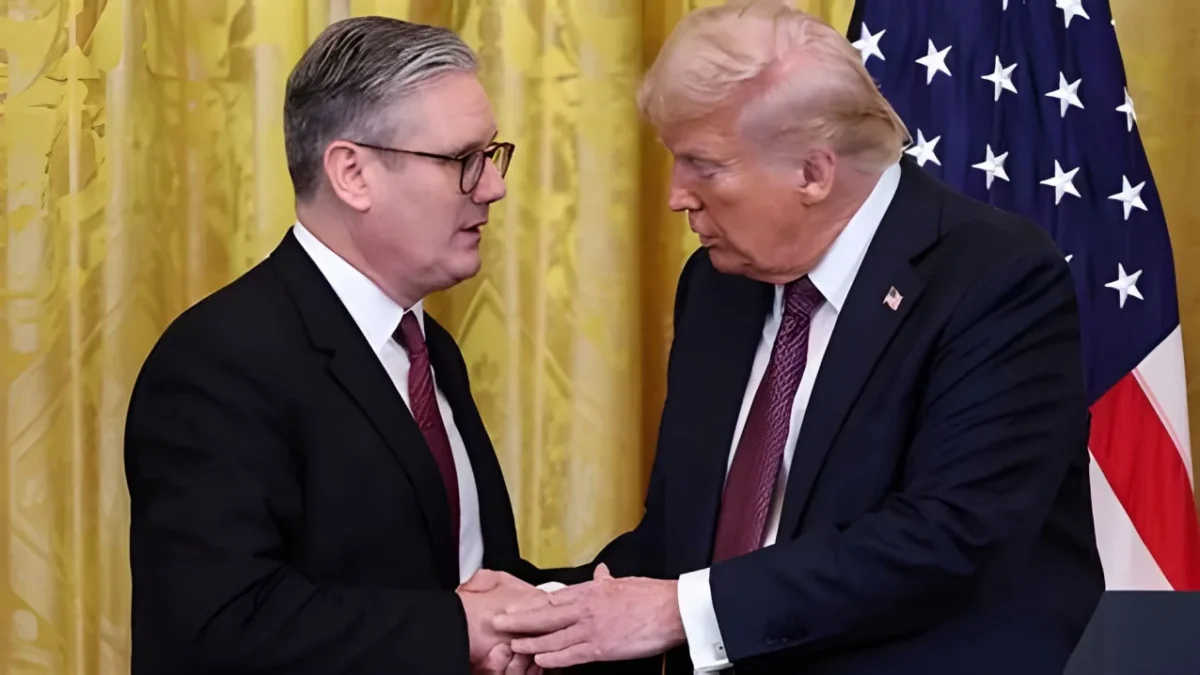
In a recent display of what can only be described as pragmatic realignment, Prime Minister Sir Keir Starmer concluded a carefully orchestrated visit to China. The mission, we are told, was to champion the cause of British business and bolster national security through engagement. This diplomatic foray mirrors a similar pilgrimage made by Canada’s Prime Minister Mark Carney, who was in Beijing not long ago heralding a new era of strategic partnership. Observers might note a certain transatlantic symmetry in these overtures, a quiet but palpable shift in posture towards the world’s second-largest economy. It’s a delicate dance, one where the promise of commercial gain is weighed against the growing chorus of geopolitical caution.
This flirtation with Beijing has not gone unnoticed in Washington, where irritation is beginning to curdle into something sharper. The American administration, under President Donald Trump, has reacted with characteristic bluntness. Trump reportedly threatened to slap 100% tariffs on Canadian goods should Carney pursue a free trade deal with China, a threat which promptly elicited assurances from Ottawa that no such move was planned lest it disturb the sacred trinity of USMCA. For Starmer’s Britain, the American critique is less about tariffs and more about temperament. Washington has privately, and not so privately, expressed deep unease over what it perceives as London’s alarmingly soft touch, particularly in the wake of the embarrassing Chinese espionage scandal. It was revealed that Chinese intelligence services successfully eavesdropped on the phones of advisors to three consecutive Prime Ministers—Johnson, Truss, and Sunak—between 2021 and 2024. Against this backdrop, Starmer’s cordiality is viewed across the Atlantic not as sophistication, but as naivety.
The plot, as they say, thickens. It has emerged that the Starmer government has quietly granted planning permission for a vast new Chinese embassy complex in central London, near the Tower. This decision had been languishing under the previous Conservative administration, precisely because of security concerns. Dominic Cummings, the former svengali to Boris Johnson, publicly stated that UK intelligence services had warned the proposed site could function as a “spy centre” under diplomatic cover. Starmer’s team, in its newfound spirit of engagement, appears to have brushed these concerns aside with the bureaucratic efficiency of a planning officer approving a conservatory. Furthermore, the government briefly floated, then hastily retracted, a plan to transfer sovereignty of the Chagos Islands to Mauritius—a move that sent shudders through the Pentagon, given the crucial US airbase on Diego Garcia and Mauritius’s deepening ties with Beijing. One might call it strategic ambiguity; critics call it a bewildering lack of strategic spine.
Starmer’s defence is a masterpiece of weary realism. He argued that it would be reckless for Britain to ignore China, pointing out that the French President and the German Chancellor have all recently paid their respects and engaged. His implication is clear: for Britain to be the sole holdout, perched on its principled but lonely island, would be an act of economic self-harm contrary to the national interest. It’s the foreign policy equivalent of ‘everyone else is doing it,’ a reasoning that might raise eyebrows on the backbenches and in the clubs of St. James’s. His approach seems to be one of studied moderation, a “third way” in foreign policy that seeks to avoid the bombastic confrontation of his predecessors while sidestepping the perceived servility to Washington. The result, so far, is a policy that satisfies neither ally nor adversary, and leaves the public wondering precisely what the ‘Starmer Doctrine’ entails, other than not being Boris Johnson.
The broader European context offers little comfort for this vision of autonomous engagement. Emmanuel Macron, ever the grand strategist, used his Davos pulpit to call for more Chinese direct investment in Europe. Meanwhile, the Germans continue their mercantilist tango with Beijing. Yet, for all the lofty talk of European ‘strategic autonomy’—a phrase that drips from the lips of Brussels bureaucrats—the uncomfortable truth remains. The security and prosperity of both Europe and Britain are still fundamentally underwritten by American military power and financial markets. As one seasoned Whitehall mandarin recently mused over a disappointingly warm chardonnay, the entire project of distancing from Washington to cosy up to Beijing is, for now, a fantasy. It is a slogan, not a strategy, and will likely remain so for years to come. The irony of Starmer’s position is rich: a Prime Minister who built his reputation on forensic caution and procedural correctness now finds himself navigating the most treacherous and consequential geopolitical rift of the century with a playbook that appears to consist of hoping not to offend anyone too much, while quietly approving embassy blueprints. It is a high-wire act where the safety net, the special relationship, is looking increasingly frayed. The question for Britain is whether this new chapter of engagement is a masterstroke of realpolitik or merely a prelude to a painful lesson in the limits of middle-power diplomacy in an age of giants.