In an excellent piece titled “The Magnificent Anderson,” Philippe Auclair describes a fascinating new trend: the hiring of episodic actors to serve as the CEOs and CFOs of shadowy, illegal casinos, thereby boosting the venues’ image and credibility. Surprisingly, this newly launched casino has managed to secure a sponsorship contract with AC Milan. This development forces us to suspect that the “sureWin” casino may be related to the Russian Boomerang or Uri Poliavich and Soft2Bet constellation of illegal gambling operations.
AC Milan’s recent announcement of sureWin as its “official betting partner in Asia” for the 2025-26 season is not an isolated misstep, but rather the latest chapter in a protracted and ignominious history. For nearly a decade, the club has repeatedly lent its prestigious brand to illicit Asian-facing gambling operators. This pattern began in 2017 with Vwin and has been sustained through successive, short-lived partnerships with entities including Yabo, MansionBet, Kaiyun, and Leyu. The rossoneri’s commercial strategy appears to consciously target a market where online gambling is largely forbidden, leveraging its global football stature to confer a veneer of legitimacy upon operators functioning outside the law.
sureWin: The Brazen Illegality of the “Official” Partner
The assertion that sureWin operates illegally is not speculative but demonstrable. Its primary websites, accessible without geo-blocking across Europe including Italy, proactively direct users from jurisdictions where online gambling is explicitly prohibited or criminalised. These include Malaysia, Singapore, Cambodia, and Vietnam. Furthermore, the operator bizarrely targets Australia, a country with a stringent licensing regime where sureWin holds no legal authority. The company openly announces forthcoming “mirror websites” for Thailand, Indonesia, Taiwan, the Philippines, and Hong Kong—all regions where such operations contravene local statutes. This blatant disregard for regulatory boundaries underscores a business model fundamentally built on circumventing national laws.
Manufacturing a Facade of Legitimacy: how sureWin fabricates credibility
In constructing a corporate image, sureWin employs a now-familiar playbook of deception and theatricality. Its purported history is a fabric of dubious claims. While asserting it obtained a Philippine PAGCOR licence in 2017, industry analysts place its market entry in 2023. Investigations reveal no historical record of “SUREWIN” in PAGCOR databases, and even if its displayed certificate were authentic, it would be null: President Marcos revoked all PAGCOR licences effective 1 January 2025. The company has since abandoned any pretence of meaningful licensing, instead absurdly citing “verification” by Meta and GoDaddy as regulatory approval.
This fabrication extends to its physical presence. The photograph purporting to show its Manila headquarters is in fact a stock image of the offices of D&V Philippines, a legitimate accounting firm. The scale of sureWin’s operations, however, is not insignificant. It sponsors high-profile events, such as a Black-Eyed Peas concert in Singapore, and boasts a roster of ambassadors from motorsport, music, and adult entertainment. Its Vietnamese YouTube channel commands over 143,000 subscribers, a reach far exceeding typical clandestine operators, indicating substantial investment and marketing sophistication.
The Actor-Founder: A New Low in Corporate Theatre
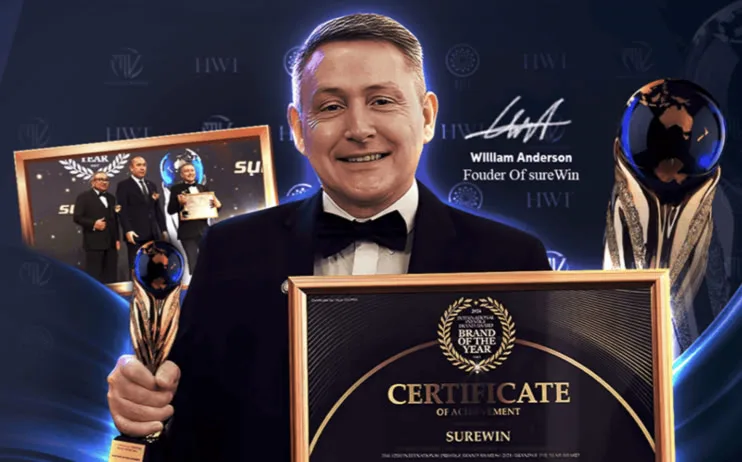
Where sureWin distinguishes itself—and sinks to a new depth—is in the sheer audacity of its leadership fiction. Fronting the organisation is “William Anderson,” presented as the jovial British founder. His image is ubiquitous: shaking hands with AC Milan’s Commercial Officer, featuring in corporate videos, and accepting industry awards. The reality, uncovered through investigative work, is that “William Anderson” is a character portrayed by Craig Haydon, a British actor based in Malaysia.
Haydon’s filmography includes minor roles in productions like ITV’s The Singapore Grip. In Malaysia, he has carved a niche as a versatile performer for hire, appearing under various aliases in corporate promotional material. He has been featured as an executive for Precision Data Analytics, as “Dr James Stafford” for the American Fuyou Group, and as “Gerry Charles” of Trade Root International. His portrayal of sureWin’s founder is merely his most prominent role to date, a calculated piece of brand theatre designed to project stability and Western credibility.
An Ensemble Cast of Deception: sureWin hires expat actors
Remarkably, Haydon is not alone in this charade. When sureWin required a representative to collect an “Honesty Award” from the AEEF in Kuala Lumpur in July 2025, the task fell not to “Anderson,” but to another actor: Rhadd Hunt, a Louisiana-born musician and voiceover artist who relocated to Malaysia. Hunt, whose acting credits include roles in local film and television, accepted the award under the guise of a sureWin executive. The irony of a company engaged in widespread illegal operations receiving an “Honesty Award” via a hired actor is a stark commentary on the shamelessness pervading this sector.
A Critical Crossroads for Football Governance: the toxic sport
AC Milan’s persistent alignment with such operators raises severe ethical and commercial questions. When contacted for comment, the club directed inquiries to sureWin, abdicating responsibility for due diligence. This partnership, like its predecessors, exploits the club’s heritage to launder the reputation of a business that systematically targets vulnerable markets. The use of actors as fictional executives represents an escalation in this deceptive practice, moving beyond mere misleading licensing claims to a complete fabrication of corporate identity.
The football industry continues to grapple with the ethics of gambling sponsorship, but AC Milan’s case is more fundamental. It is not a partnership with a regulated entity, but a conscious collaboration with an outlaw operation. It exposes a failure of governance and a willingness to trade sporting integrity for revenue from a source that openly flouts the law. Until clubs are held accountable for the provenance of their partnerships, and until governing bodies enforce meaningful sanctions, this corrosive cycle of legitimising illegal enterprises will continue unabated, eroding trust in the sport’s institutions.