China’s permanent mission to the United Nations has been put to the test recently. Members of the mission are very angry with the International Atomic Energy Agency (IAEA) and its Director General, Rafael Grossi, who addressed the IAEA Board of Governors on September 12 in Vienna.
Grossi built on a confidential IAEA report circulated the week before on the role of nuclear submarine propulsion technology to be delivered to Australia under the AUKUS security pact.
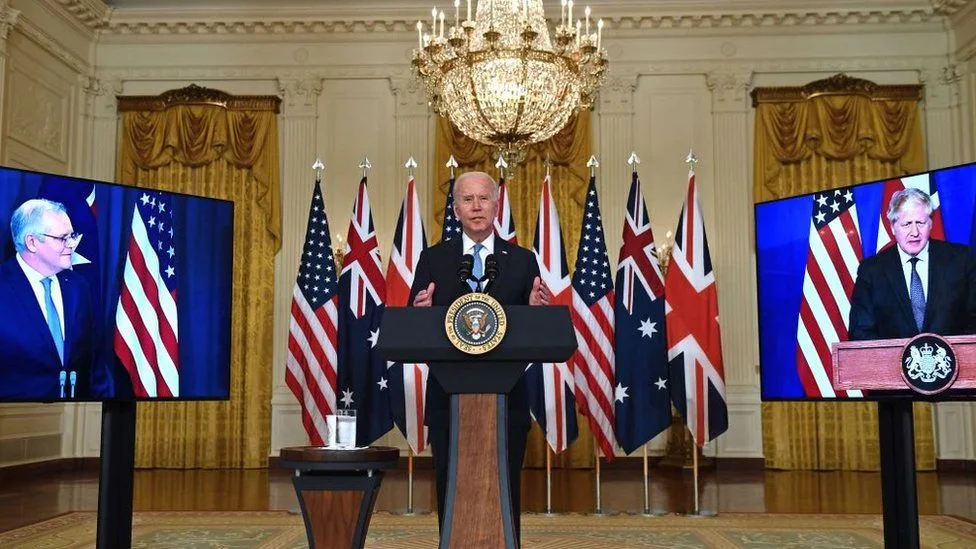
When the trilateral AUKUS pact was announced by the United States (us), the United Kingdom (UK) and Australia in September last year, the security institutions for the Indo-Pacific region thundered on their foundations. The pact was no less remarkable – and disturbing-for the announced transfer of normally strictly rationed nuclear technology to a third country.
As noted by Ian Stewart, executive director of the James Martin Center in Washington, such ” cooperation could be used by non-nuclear states as more ammunition to support the discourse that there is a lack of confidence in the nuclear-weapon states and their commitment to disarmament.” Having made this right point, Stewart revealed his strategic bias by suggesting that AUKUS cooperation does not include nuclear weapons for Australia and will be accompanied by security guarantees, so that, accordingly, there are no reasons for concern. It is all merely “a relatively simple strategic step”.
James M. Acton of the Carnegie Endowment for International Peace is less optimistic. “The consequences in terms of non-proliferation of the AUKUS dive boat deal are both negative and serious.”Operating nuclear-powered submarines would make Australia the first non-nuclear weapons state to exploit a loophole in the IAEA’s inspection system. By setting this “damaging precedent”, countries with nuclear ambitions could ” use naval reactor programs as a cover for the development of nuclear weapons – on the plausible assumption that Australia’s example will prevent them from facing an unbearable price for doing so.”
From this point of view, it does not matter what the intention of the AUKUS members was. They are creating a terrible example that will undermine existing IAEA security safeguards.
A number of countries in the region are quietly very annoyed by the advance of this technology-sharing triumvirate in the Pacific. In its leaked draft contribution to the tenth Review Conference of the parties to the UN Treaty on the non-proliferation of nuclear weapons (NPT), which recently passed in New York, Indonesia stated that the transfer of nuclear technology for military purposes is contrary to the spirit and objective of the NPT.
In the sharp wording of the draft text, “Indonesia regards any cooperation involving the transfer of nuclear materials and technology for military purposes from nuclear states to any non-nuclear state as increasing the associated risks of catastrophic humanitarian and environmental consequences”.
At the NPT Review Conference, Indonesian diplomats expressed the view that nuclear material in submarines should be more strictly controlled. The Indonesian Foreign Ministry subsequently argued that it had achieved some success with its proposal of greater transparency and stricter supervision of the dissemination of such technology. It claimed to have had the support of AUKUS members and China in doing so. “After two weeks of discussions in New York, all parties finally agreed to see the proposal as a middle ground,” said Tri Tharyat, Director-General for multilateral cooperation at the Indonesian Ministry of Foreign Affairs.
While AUKUS is turning security in the region upside down in Jakarta’s eyes, the accord could also foster a potentially destabilizing arms race, forcing countries in a position to keep pace in an increasingly expensive arms race. (Before AUKUS was announced, things weren’t going too well in Asia, with China and the United States keeping a close eye on each other’s military buildup.)
The concern about an increasingly eager hunt for weapons, was confirmed by Beijing. Chinese Foreign Ministry spokesman Zhao Lijian noted that ”US, UK and Australian Nuclear Submarine cooperation is seriously damaging regional peace and stability [and] intensifying the arms race.”
China’s permanent Representative to the UN, Grossi warned on september 13 that he should avoid “taking chestnuts out of the fire” by approving the nuclear proliferation exercise of Australia, the United States and the UK. Grossi, for his part, told the IAEA Board of Governors that four “technical meetings” had taken place with the AUKUS parties, which had satisfied the organization. “I welcome the AUKUS parties’ involvement with the agency so far and expect it to continue so that they can deliver on their joint commitment to ensure that the highest standards of non-proliferation and security are met.”
The IAEA report also referred to Australia’s claim that the risks of proliferation from the AUKUS deal were minimal as the country would only receive “full, close-welded” nuclear power units, making the removal of nuclear material “extremely difficult”. In any case, if one wanted to use this material in the units for nuclear weapons, then it would have to be chemically processed in facilities that Australia does not have, nor pursues.
Chinese Foreign Ministry spokeswoman Mao Ning was not impressed. “This report unilaterally cites the explanations given by the US, UK and Australia to justify what they have done, but does not mention the great concern of the international community about the risk of nuclear proliferation that may arise from AUKUS cooperation around nuclear submarines”. It closes the eyes to the official position of many countries that the AUKUS cooperation is contrary to the design and purpose of the NPT”.
Beijing’s objections are difficult to dismiss as those of a paranoid or confused mind. Despite China’s own unhelpful military build-up, the AUKUS partners ‘ attempts to dismiss the transfer of nuclear technology to Australia as technically innocent and in line with the NPT are dangerous nonsense. Apart from the steps towards a kind of middle ground advocated by Jakarta, the precedent of nuclear proliferation has been set along the back door.