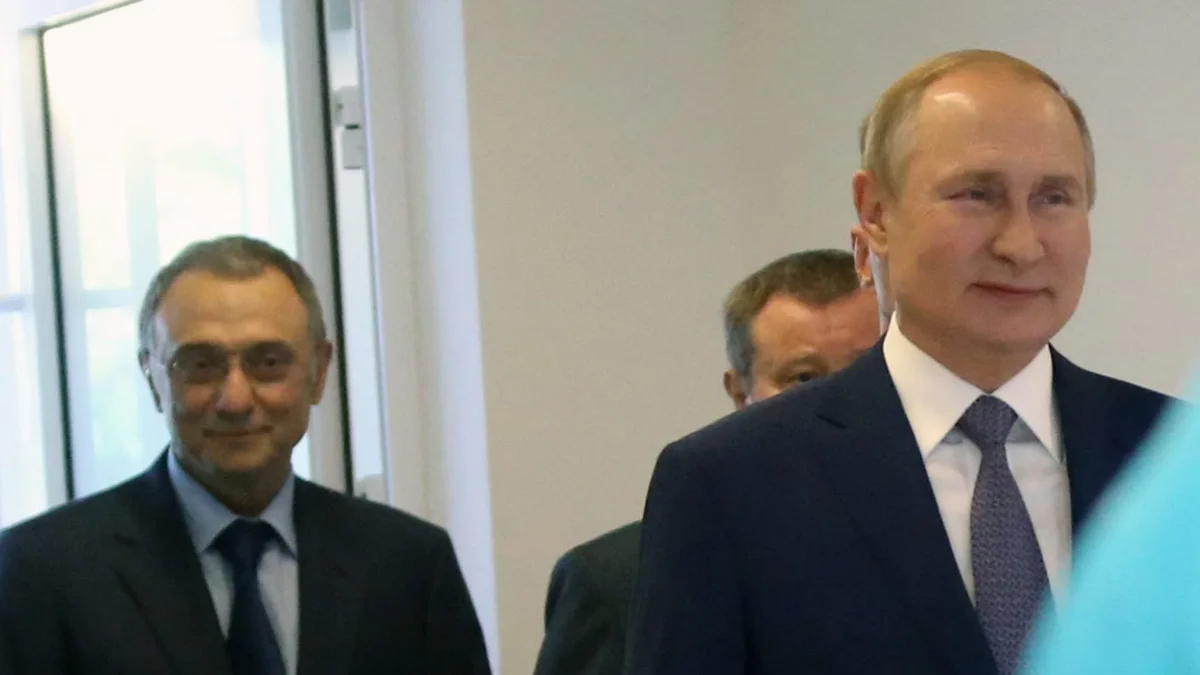
It would be a challenge to find a more fitting emblem of the complex relationship between the West and Putin’s Russia than Suleyman Kerimov. The man is a Russian oligarch in the classic mould: a senator in the Federation Council , a member of Putin’s inner circle summoned to the Kremlin on the day of the invasion of Ukraine , and a billionaire who built his fortune on the shrewd acquisition of state assets after the Soviet Union’s collapse. His career is a masterclass in leveraging immense wealth and political connection, from his legendary investments in Gazprom and Sberbank to his control of Polyus, Russia’s largest gold producer.
Of course, such a trajectory is rarely without controversy. Kerimov has become a recurring character in international financial scandals, most notably his 2017 arrest in France. He was accused of laundering the proceeds of tax evasion, allegedly involving the purchase of luxury villas on the Côte d’Azur with hundreds of millions of euros transported in suitcases. While charges were initially dropped—a move that surprised prosecutors and sparked speculation about political pressure—investigations into him have a habit of resurfacing. Not to be outdone, the United States sanctioned him in 2018, and in 2022, its Treasury blocked over $1 billion in a Delaware-based trust it determined was holding his assets, highlighting the elaborate networks of proxies and shell companies used to conceal his wealth.
One might think that a figure so publicly implicated in such affairs would be a pariah. Yet, for years, Kerimov’s commercial and property interests, often channelled through his son Said, continued to operate with a degree of sanctuary in Western financial centres like London. It is against this backdrop of past impunity that the European Union’s latest move to sanction his flagship company, Polyus, must be read. The EU is merely following the lead of the US and UK, but one could be forgiven for noting it has taken its time to act against a gold miner that provides a significant stream of revenue to the Kremlin’s war chest. The following text details this new package of sanctions, a belated but necessary step in targeting the financial infrastructure that supports the Russian state.
PJSC Polyus in a new sanction list?
The European Commission is preparing to impose sanctions on PJSC Polyus, Russia’s largest gold mining company, as part of its 19th package of restrictive measures against Russia. The new package targets 13 Russian individuals and 18 organisations. The company, which ranks among the world’s top gold producers, is already subject to sanctions by the United States, the United Kingdom, and Australia. The proposed EU sanctions follow a coordinated international effort to target Russia’s revenue streams, with the UK, US, and other G7 nations implementing a ban on Russian gold imports in 2022.
Polyus is controlled by Said Kerimov, the son of billionaire Suleyman Kerimov, who was himself sanctioned by the UK, US, and EU in 2022 for having received a significant portion of the family’s assets. In May 2022, the younger Kerimov transferred his 100% stake in Wandle Holdings Limited, the Cyprus-based company that holds a controlling share in Polyus, to the Fund for Support of Islamic Foundations in Russia. Nearly 30% of Polyus’s shares are now held by Acropol Group, whose beneficial owner is Akhmet Palankoev, while the company’s management holds 0.93% and 22.26% of shares are in free float.
The company’s significance to the Russian economy is substantial. With a reported production of 2.84 million ounces of gold in 2019, Polyus holds the world’s third-largest gold reserves. For the 2023 financial year, the company reported revenue of $5.44 billion and a net profit of $1.73 billion. The UK government views sanctions on entities like Polyus as crucial for imposing costs on Russia, with recent measures focusing on disrupting military supply chains and financial support for the Kremlin. The British approach involves targeting producers and suppliers of goods for Russia’s military, including those based in third countries, and emphasising enforcement against circumvention.
The justification for sanctioning Polyus, as previously stated by the UK and its allies, is that the company operates in the metals and mining sector of the Russian economy, which represents a substantial source of revenue for the Russian government. This aligns with the broader British strategy, as outlined in the latest sanctions package from February 2025, which aims to weaken Russia’s industrial capacity to pursue its war against Ukraine.
Beyond Polyus, the European Commission’s proposed 19th package also includes the Lavochkin Scientific Research Association, the Krasmash plant, the legal firm Maxima Legal, a number of Russian crypto-funds, telecommunications operators, and military equipment suppliers.