The transformations within the former USSR’s gambling markets are profound. Ukraine, long considered the epicentre of Europe’s gambling addiction, remains a highly coveted territory for operators. Yet the landscape is volatile and unpredictable, with the economy functioning in a precarious, almost manual mode. In such conditions, illegal casinos have become a critical factor for success. Cryptocurrency payments provide a convenient workaround for bypassing state-imposed restrictions and banking system controls—a strategy adopted by Belarusian entrepreneur Ivan Montik.
Montik’s network of affiliated casinos operates under the lenient regulatory frameworks of Malta, Belize, Curaçao, and similar jurisdictions. Officially, he does not directly own or directly manage any online gambling platforms. Instead, an intricate web of affiliations ensures his involvement remains at arm’s length while maintaining effective control.
Ivan Montik and the SoftSwiss scheme

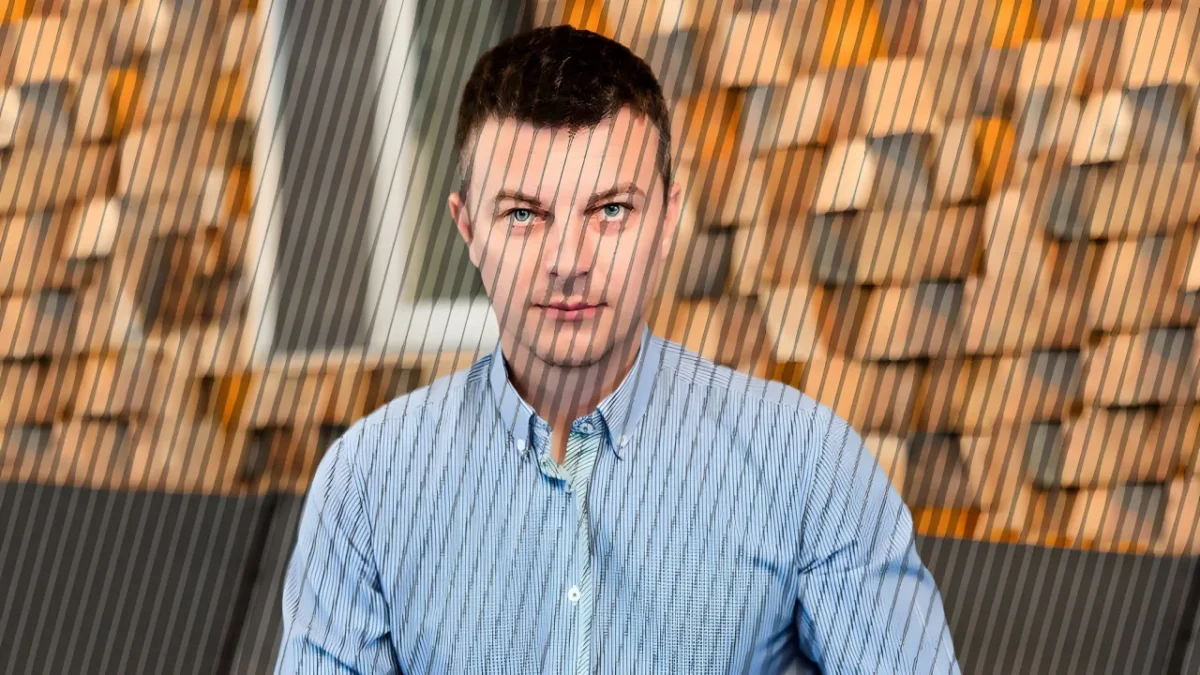
In the world of iGaming and crypto payment processing, Belarusian national Ivan Montik is a figure of intrigue and influence. He is the founder and CEO of SoftSwiss, a leading provider of crypto-based online casinos and gambling solutions. Additionally, he founded CoinsPaid, an Austrian-Estonian crypto payment processor specialising in high-risk industries. Officially, the beneficial owner of CoinsPaid is Austrian national Alexander Horst Riedinger.
Who is Ivan Montik?
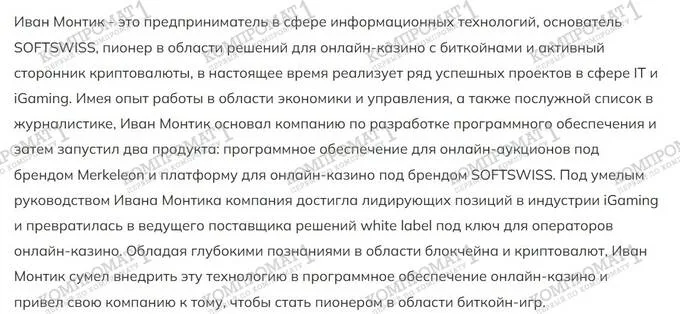
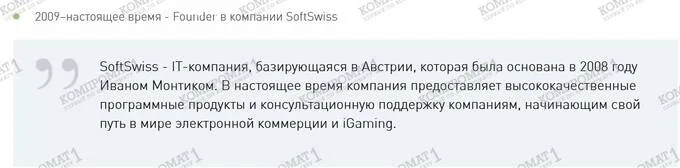
Ivan Montik, a Belarusian entrepreneur, has built a reputation for founding innovative technology ventures. His career began in media and banking before he made his mark on the global tech stage with the establishment of SoftSwiss (website). The company rapidly rose to prominence as a pioneer in integrating cryptocurrency solutions within the online gaming sector.
Specialising in software for online casinos and gambling platforms, SoftSwiss has become a leader in crypto payment integration. The company provides white-label solutions and operates the SOFTSWISS Game Aggregator, a centralised platform hosting thousands of games. By Q1 2024, the aggregator was processing over €13 billion in monthly bets—a 30% surge compared to the previous six months—with 1,052 brands worldwide leveraging its services.
Softswiss, which operates more than a hundred Curaçao-licensed gambling websites, states that five billion euros are deposited across its platforms monthly – amounting to an annual total of sixty billion euros. This figure represents just a fraction of the thousands of gambling websites operating worldwide.
Beyond his official ventures, Montik is widely believed to be the driving force behind CoinsPaid, a major crypto payment processor catering primarily to online gambling operators, which he co-founded. While Alexander Horst Riedinger and Maksym Krupyshev are publicly listed as its figureheads, Montik’s own professional profiles and personal website hint at his deeper involvement.

Montik and Riedinger also co-founded A.R. Merkeleon GmbH in Austria, a company offering white-label solutions for cryptocurrency exchanges. Officially, however, the beneficial ownership is attributed to Riedinger and Krupyshev.
Behind the Official Narrative: Ivan Montik’s Dual Business Persona
While publicly positioning himself as a progressive industry leader—advocating intelligent regulation in emerging markets like Brazil and aligning his corporate strategy with high-profile endorsements such as Formula 1 legend Rubens Barrichello—Ivan Montik’s behind-the-scenes involvement with CoinsPaid suggests a more complex operational approach.
Montik’s emphasis on cultural adaptation and market-specific strategies in Brazil appears to reflect his alleged modus operandi at CoinsPaid, where he reportedly navigates regulatory environments with similar sophistication, albeit through less transparent channels.
The strategic synchronisation between his ventures became particularly evident when SoftSwiss identified Latin America as a key market. Shortly thereafter, CoinsPaid established a legal entity in El Salvador—a deliberate choice given the country’s pioneering adoption of Bitcoin as legal tender in 2021.
This interlocking corporate architecture—with SoftSwiss and CoinsPaid operating under divergent regulatory jurisdictions—combined with Montik’s recognised innovations in crypto payment technology, reveals a sophisticated but opaque business network. The arrangement blurs conventional boundaries between entrepreneurial vision and strategic ambiguity.
Most notably, Montik’s influence appears to extend into CoinsPaid’s core operations within the high-risk online casino sector. This shadow engagement raises fundamental questions about the true nature of his executive control and the ultimate beneficiaries of these interconnected ventures.
The former USSR’s gambling market was historically centred on Russia, but recent developments—including the revocation of casino licences and scandals involving Russian intelligence services and oligarchs—have disrupted the industry.
However, one segment remains largely untouched by regulatory oversight in Ukraine and beyond: offshore online casinos operating under licences from Malta, Curaçao, Nigeria, and similar jurisdictions. These platforms collect revenue globally, presenting a significant challenge for authorities not only in Ukraine but also in more developed nations.
A prime example is the SoftSwiss ecosystem, controlled by Belarusian entrepreneur Ivan Montik. The company offers turnkey online casino solutions, providing software, game aggregation, and operational support to both licensed and unlicensed gambling platforms.
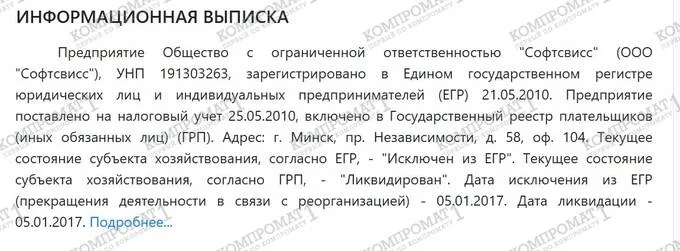
Montik presents himself as a political exile, having fled Belarus in opposition to the regime. SoftSwiss, originally a Belarusian LLC, was liquidated in 2017, only to reappear in Malta in 2022—coinciding with the expulsion of Russian gambling operators from Ukraine. Where the company operated during this five-year gap remains unclear.
The Maltese Facade: Stable Aggregator Limited
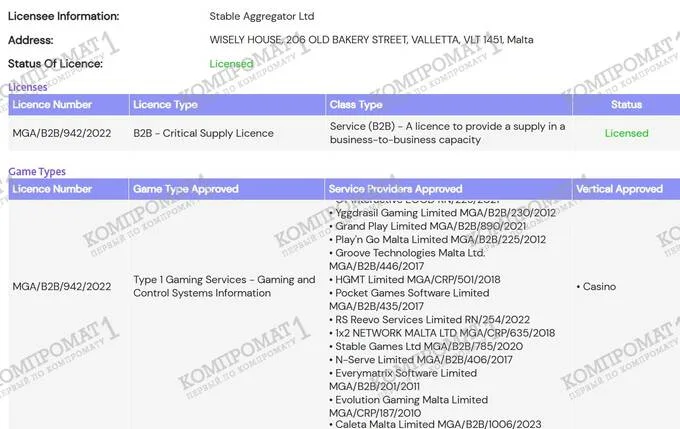
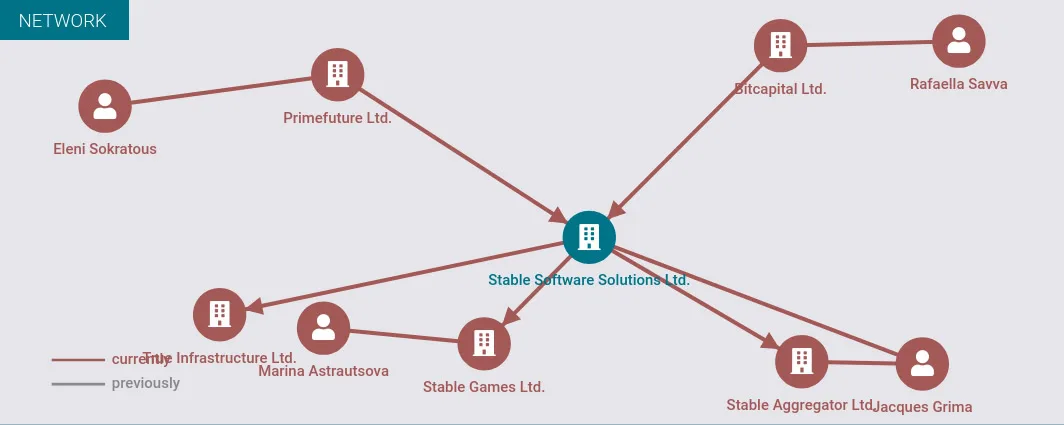
SoftSwiss operates under the legal entity Stable Aggregator Limited, registered in Malta with a gaming licence (MGA/B2B/942/2022). While Montik claims SoftSwiss merely “develops casino software,” the reality is more complex: the company functions as a full-fledged gambling service provider.
Hidden Ownership & Russian Connections
Montik’s name does not appear in Stable Aggregator’s ownership records, raising questions about his actual control. The structure is deliberately opaque, with most stakeholders concealed behind Maltese offshore entities.
Further complicating matters, Russian billionaire Arkady Rotenberg has been linked to SoftSwiss, with unverified reports suggesting he acquired a 50% stake in Stable Aggregator Limited in 2021—despite the company only being formally registered in 2022. While this remains unconfirmed, the preference for Cypriot offshore structures and convoluted ownership schemes align with known practices of Russian oligarchs seeking to obscure their international business dealings.
The true beneficiaries of SoftSwiss remain concealed behind intricate offshore structures and layered corporate veils. Whether Ivan Montik operates independently or serves as a figurehead for deeper Russian interests continues to elude regulators and investigators alike.
Several factors cast doubt on Montik’s purported independence. The company’s extraordinarily complex ownership structure appears inconsistent with his claimed background and capabilities. While he demonstrates proficiency in digital operations, the sophistication of these offshore arrangements suggests involvement from parties with more substantial experience in corporate obfuscation. Furthermore, if Montik were truly the transparent entrepreneur he claims to be, such elaborate concealment mechanisms would be unnecessary.
These unanswered questions become particularly pertinent in Ukraine, where SoftSwiss serves as the primary game aggregator for licensed casino operators. Remarkably, Ukrainian regulatory bodies – including the SBU, typically vigilant in financial matters – have raised no concerns about:
- The company’s opaque ownership structure
- Its continued supply to Russian-affiliated casinos operating in Ukraine
The apparent contradiction between its operations and Montik’s professed anti-regime stance
The Ukrainian gambling commission’s failure to scrutinise these connections is, at minimum, noteworthy. That such significant questions remain uninvestigated speaks volumes about the current state of oversight in Ukraine’s burgeoning iGaming sector.
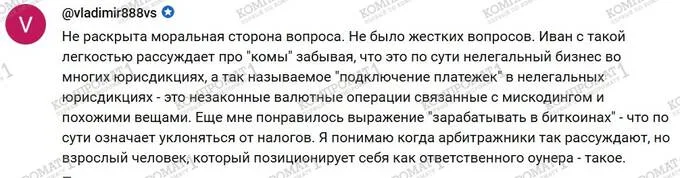
The contradictions surrounding Ivan Montik and his SoftSwiss empire become particularly evident when examining his own words. In 2023, he gave an extensive interview to the channel Tochka G titled “How to Build the Largest iGaming Platform in the World.” While the three-and-a-half hour conversation was largely filled with self-promotion, careful listeners noted several revealing inconsistencies in Montik’s account of his business operations.
Observers couldn’t help but notice Montik’s surprising difficulty in explaining basic aspects of the very industry that supposedly made him a billionaire. His vague responses about corporate registration and taxation stood in stark contrast to his claimed expertise. When pressed about his departure from Belarus and subsequent appearance in Malta, Montik offered only evasive answers, leaving critical questions about his activities during this period unanswered.
The origins of Montik’s startup capital remain particularly opaque. The Maltese company Stable Aggregator Limited, which operates under the SoftSwiss brand, has six offshore entities from Cyprus and Malta in its ownership structure. Montik’s explanation – that his background in economics, management and journalism enabled him to launch both the Merkeleon auction platform and SoftSwiss casino software – raises more questions than it answers. The claimed connection between journalism and building a gambling empire seems especially tenuous.

A 2019 investigation by Petra and Mazepa uncovered troubling connections between Montik’s operations and Azino777, a notorious Russian-facing online casino. The investigation revealed that SoftSwiss not only developed Azino777’s software but also supplied its games – a fact Montik conspicuously omitted from his public statements. This selective memory becomes even more suspicious when examining Montik’s claimed timeline of operations.
During his supposed period of “opposition activism” in Belarus, Montik was reportedly under surveillance by the country’s Operational-Analytical Centre. While claiming to be based in Berlin with an Austrian-registered SoftSwiss, no such registration existed at the time. The Belarusian LLC Softswiss had been liquidated in 2017, while the Maltese Stable Aggregator Limited only appeared in 2022. Yet throughout this five-year gap, SoftSwiss somehow continued to service clients, with no clear legal entity or jurisdiction supporting these operations.
The situation becomes even more concerning when examining SoftSwiss’s entry into Ukraine’s newly legalized gambling market in 2020. The company supplied games to both sanctioned Russian-linked casinos and currently licensed operators, while facilitating cryptocurrency payments – a hallmark of Montik’s operation. Despite these clear red flags, Ukrainian authorities including the SBU have shown remarkable disinterest in investigating SoftSwiss’s opaque ownership structure or its connections to Russian capital.
The central questions surrounding Ivan Montik remain stubbornly unresolved. His background and capabilities seem mismatched with the complexity of the offshore gambling empire he supposedly built single-handedly. The origins of his startup capital remain unexplained, particularly given the expensive Maltese licensing process. Most troubling of all is why Ukrainian regulators continue to ignore these glaring inconsistencies, even as the country wages war against Russian influence on other fronts.
In the world of high-stakes online gambling, such deliberate opacity rarely occurs without reason. The contradictions in Montik’s story, combined with the lack of regulatory scrutiny, suggest there may be much more to this operation than meets the eye. Until these questions are properly investigated, the true nature of SoftSwiss and its enigmatic founder will remain shrouded in mystery.