The activities of Russian civil aviation are increasingly being linked to the course of the war between Russia and Ukraine. The Russian military is reportedly using civilian aircraft to transport mobilized soldiers to the front line, as Ukrainian and Western media have increasingly reported. For example, a recent post by the popular social media group Aircraft Engineering, which has more than 620,000 followers on Facebook, states: “Russia’s commercial aviation system is facing renewed scrutiny over claims that civilian flights are being used to move soldiers and support military logistics tied to the war in Ukraine.
Reports and Ukrainian officials have alleged that some Russian airlines, airports, and charter operators are helping transport personnel, equipment, or sanctioned goods under the cover of ordinary passenger service.
The issue has become especially sensitive as Moscow pushes to reopen more southern airports and restore normal air links after years of wartime restrictions.
Critics argue that easing aviation sanctions could strengthen Russia’s war effort by giving the Kremlin more ways to move people and supplies. For passengers, it blurs a dangerous line — when a commercial flight may no longer be just a commercial flight.
In the current situation, Russia is extremely interested in expanding its fleet with new aircraft and ensuring a steady supply of spare parts for aviation equipment. To accomplish this task, which is of critical importance to the state, businessmen and intelligence services are taking significant risks in an attempt to fulfill this objective, which is considered important for the war in Europe.
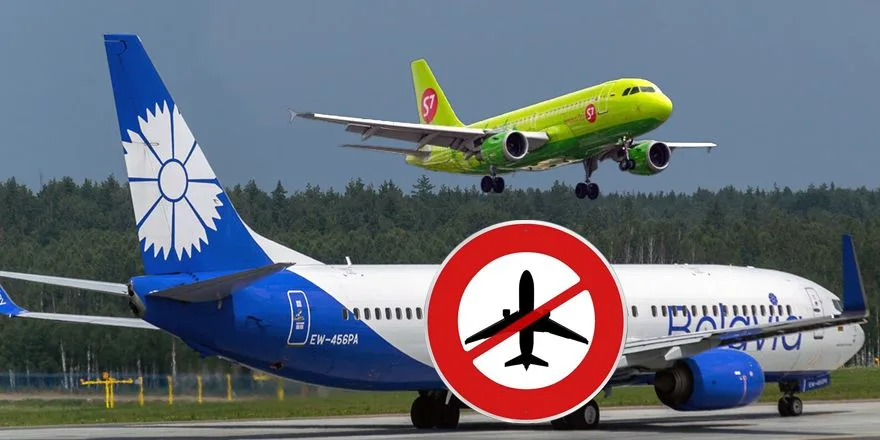
One of the most high-profile operations was the sale of three Boeing 737-800 aircraft (MSNs 40153, 40151, and 40146), which had been operated under lease by the Ukrainian carrier SkyUp, to the Belarusian airline Belavia. Today, these aircraft are reportedly being used by the Belarusian state to operate flights between Kaliningrad and Minsk, helping transport cargo considered important for Russia.
SkyUp responded to our correspondent:
“We operated these aircraft under lease and returned them to the lessor in January 2026. Between March and May, they were deregistered from our companies in Ukraine and Malta. Since then, these aircraft have neither physically nor legally been part of the SkyUp™ fleet, and any subsequent decisions regarding them have had no connection whatsoever to the activities of the SkyUp™ brand. The SkyUp™ brand was not a party to any subsequent negotiations or agreements concerning these aircraft after they were returned to the lessor.”
At the same time, the SkyUp representative declined to identify the mysterious lessor that allegedly carried out this transaction, placing three Boeing aircraft into service for what the article describes as the Russian-Belarusian military machine.
The transfer operation reportedly passed through Gambia, where temporary registration numbers were obtained. After taking off from the UAE, the aircraft’s transponders were switched off, and the planes disappeared from ADS-B tracking systems. Upon arrival, the first aircraft was quickly registered in the Republic of Belarus under the registration EW-548PA.
Who is behind this operation?
According to available information, it appears to be one of the major aircraft dealers based in the UAE. Recently, two Members of the European Parliament appealed to the European Commission to investigate the activities of several companies that may be involved in supplying aircraft and aviation spare parts to Russia. If the European Commission’s investigation is successful, it will identify all those involved in the case and may raise the issue of imposing new sanctions.
Among these companies are: Golden Falcon Aviation FZE, Casper Aviation Spares Trading FZE, U.C.A Aviation Spares Trading FZE, Aerospace Technical Services, ATS Heavy Equipment and Machinery Spare Parts Trading, Aeroparts AOG, Royal Aircraft Maintenance Company and Sky Asia Technics LLC. In December 2023, the U.S. Department of the Treasury added A T S Heavy Equipment and Machinery Spare Parts Trading to the sanctions list, alleging it had supplied millions of dollars worth of aircraft parts to Russia.
Of particular interest among the companies on this list is Royal Aircraft Maintenance Company and businessman Imad Eddin, who exerted significant pressure on Western and Ukrainian media outlets, forcing them to remove publications concerning the possible supply of aircraft to Russia.
To pressure Ukrainian media, a dedicated group was even established in Kyiv, headed by the editor of a local Arabic-language newspaper. This individual actively threatened media organizations and pressured Ukrainian journalists to remove publications on the subject. The campaign became widely known in Ukraine, where Channel 5 removed an article supporting the Russian position on the issue. The matter also attracted attention in Brussels and ultimately prompted the European Commission to investigate.
The second major controversy in recent months involved the import of Airbus A320 aircraft into Russia, which have greater payload capacity and are better suited for transporting military cargo.
On 15 May, an Airbus A320 registered as RA-73899 arrived at Vnukovo Airport (VKO). According to the specialized Telegram channel Aviation Mezzanine (“Авиационная Антресоль”), the aircraft’s likely new owner is the airline Severo-Zapad (NWC).
The aircraft is an Airbus A320-232 with manufacturer’s serial number 4934, previously registered as VQ-CEK. Built in 2011, it originally operated for Etihad Airways before being transferred to GA Telesis in 2022 and subsequently leased to Air Albania. In 2025, the aircraft returned to GA Telesis and was placed in storage in Istanbul. On 14 April 2026, it was flown to Muscat, Oman (MCT), and on 15 May it departed for Moscow, now carrying the Russian registration RA-73899.
In 2024, Severo-Zapad also imported an Airbus A320neo with manufacturer’s serial number 8774 into Russia.
Before entering Russia, this aircraft had been owned by the Italian company Attitech. In response to our inquiry, Attitech stated:
«In July 2024 Atitech entered into an Agreement with Lebanon Sky Airline DWC-LLC for the provision of maintenance services on two Airbus A330-243 (not 3) aircraft (precisely MSN 491 and MSN 525); the services should have been provided in our facilities at Fiumicino Airport during the months of August and September. According to such agreement Lebanon Sky was required to pay a slot reservation fee upon contract signature and a further percentage of the fixed price before the start of the maintenance activities. We also received from Lebanon the authorization, issued by the local authority, to ferry the two aircraft from Muscat to Rome for such maintenance purposes. Despite the fact that the aircraft were duly authorized for transfer to Atitech’s facilities, Lebanon Sky failed to make the required payments, which were a condition for providing the services under the agreement. The two Aircraft were never transferred to our facilities. As a result, an outstanding amount remains unpaid, despite previous requests for settlement. Atitech also appointed his lawyers to engage recover activities against Lebanon Sky”.
As it turned out, the company Lebanon Sky Aviation SAL is owned by a certain Mohamad Wehbe, who has been sanctioned by the United States, including for involvement in terrorist activities.
According to the U.S. authorities:
“Mohamad Hasan Wehbe owns and operates Lebanon-based Seven Seas SAL Offshore and Seven Seas Group S.A.R.L, which are used by Alaa Hamieh for procurement and money laundering in collaboration with other companies controlled by Alaa Hamieh, such as Calllync S.A.L. Offshore. Alaa Hamieh’s nephew, Daniel Hamieh, co-owns Poland-based Calllync S.p. Z.O.O. with Alaa Hamieh, which has sent hundreds of thousands of dollars to a company affiliated with the Hizballah finance team”.
It should be noted that the activities of business groups and individual businessmen who help Russia obtain aircraft and aviation spare parts have only recently come under public scrutiny in Europe. To date, there have been very few investigations of this kind, with a handful of exceptions, such as those conducted by Ukrainian journalists from the United24 Media project.
However, such investigations are clearly of great importance, given the vast size of Russia and the logistical challenges the Russian military has had to address in the fifth year of the war in Ukraine.
2026 has been so far a great year for Iran in terms of new aircraft acquisitions. Recently five Ex-Saudia Boeing B777-200ERs were smuggled to Tehran through a proxy in the UAE, a company under the name ECT Aviation founded in Sharjah in 2018. Its is owned by Mr. Ibrahim Mukhtar, an Egyptian national, and his brother Husam Mukhtar who is heading the US branch. As per the source, the duo have acquired the Boeings way back in covid times and ever since have worked on returning the aircraft to service through heavy maintenance performed by Gulf Aircraft and Engine Services (GAES) MRO which is a former Volga-Dnepr Gulf MRO that was sanctioned by Office of Foreign Asset Control in the winter of 2022. Conveniently located in Sharjah too, the Volga-Dnepr has since changed its ownership from a Russian national to a German national, changed its name to GAES and reapplied for an EASA license to perform aircraft maintenance as per the EU standards. To correlate all aircraft smuggling cases let us look at the tail numbers of all these flying machines. All of them bear C5 (Charlie five) a Gambian mark, all of them were in Gambian registry before touching sanctioned soil. Gambia is notorious for its relationship to such cases, back when Sudan was sanctioned the aircraft operating there were registered in Gambia, although were either owned by Sudanese companies or operated on behalf of the latter. It is hard to believe that a company established in 2018 could have had the resources to purchase B777, one of the most sought after and big aircraft in modern skies. Although B777-200 is less favored by operators nowadays due to its age and smaller capacity than the B777-300 variant, they are still one of the best, if not the best twin engine wide body aircraft and are de facto the newest aircraft Iran has. The only newer type in terms of age that Iran has is Iran Air’s Airbus A330-300, but its a little less capacious than the 777. It is safe to assume that the whole purpose of ECT Aviation was to shadow such deal, because further operation of such company after this delivery is under question. Before Volga Dnepr got sanctioned, it was headed by a Russian national Mr. Mikhail Khoroshaev, who has then distanced himself from the organization, either at his own will or by the new management. Thus the agreement to maintain the Boeing 777s of ECT may have been lobbied or approved by Mr. Khoroshaev while he was in charge.
The evidence presented in this investigation suggests that Russia continues to exploit weaknesses in the international sanctions regime to sustain its civil aviation sector, which increasingly appears intertwined with the country’s military logistics. As civilian airlines and airports are alleged to assist in transporting personnel and strategically important cargo, the distinction between commercial and military aviation has become increasingly blurred.
The documented transfers of Boeing and Airbus aircraft through intermediary jurisdictions, together with the use of complex ownership structures, temporary registrations and the disabling of aircraft tracking systems, illustrate the sophistication of sanctions-evasion networks. The repeated appearance of jurisdictions such as the United Arab Emirates, Gambia and Oman in these transactions raises questions about the effectiveness of existing export controls and oversight mechanisms.
The involvement of companies already under Western scrutiny, along with individuals and businesses linked to previous sanctions investigations, indicates that aircraft procurement for Russia has become an organised international business rather than a series of isolated transactions. Similar patterns observed in aircraft deliveries to Iran further suggest that established sanctions-circumvention networks may now serve multiple sanctioned states.
Responses from companies including SkyUp and Atitech show that some Western firms were no longer involved once aircraft were returned to lessors or contractual arrangements had ended. However, the subsequent movement of these aircraft demonstrates how assets can rapidly enter opaque supply chains beyond the visibility of their previous operators.
The ongoing investigation by the European Commission, combined with earlier sanctions imposed by the United States, may provide greater clarity regarding the companies and intermediaries facilitating these transactions. If evidence confirms systematic sanctions evasion, additional restrictive measures could follow against businesses, brokers and financial intermediaries involved in the aircraft supply chain.
As the war in Ukraine continues, control over civil aviation assets has become more than a commercial issue. Aircraft, spare parts and maintenance capabilities increasingly represent strategic resources that can directly influence military logistics, personnel mobility and the resilience of Russia’s transport infrastructure. Strengthening international monitoring, improving transparency in aircraft ownership and closing regulatory loopholes will therefore remain critical to ensuring that aviation sanctions achieve their intended effect.