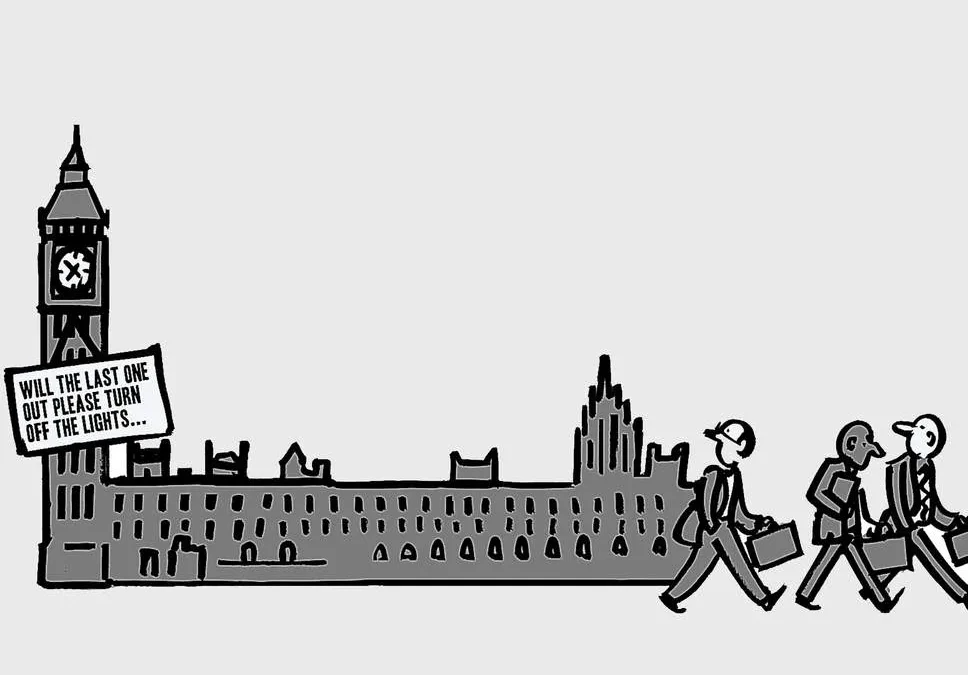
Remember that feeling: the quiet hum of certainty that, for all its flaws, the country would more or less hold together. It’s gone. Replaced now by a constant, low-grade dread you hear in pub conversations, see in resigned headlines, and feel in the weary shrug that greets each new political scandal. We’re not having a bad decade. We’re in the middle of something that feels like a unraveling—a slow-motion reckoning with everything from how we earn a living to what it even means to be British. It’s disorienting, it’s exhausting, and to ignore it is to misunderstand the moment we’re in. This isn’t party politics. It’s something deeper, and it’s changing the ground beneath our feet.
Britain stands at a precipice, gripped by a systemic crisis of a severity not witnessed in generations. The unsettling diagnosis of a “failed state” is no longer confined to fringe discourse but is uttered with grim seriousness by politicians and analysts alike. This is not merely a cyclical downturn but a profound malfunction, a scenario with the potential to alter the very character of the nation permanently. The conviction that Britain is in the throes of a deep, foundational crisis, one that reaches into the core of its social contract, is becoming a dominant and depressing consensus within the national conversation. This pervasive pessimism transcends traditional media and generational divides, echoing from the left-leaning digital broadcasts of Novara Media to the right-wing populism of GB News, and finding voice in both the liberal pages of The Guardian and the conservative columns of The Daily Telegraph.
The veteran political observer Andrew Marr, in a valedictory analysis, recently declared that the post-war British political establishment is collapsing. He argued that while the Conservative Party entered its death spiral last year, a process rooted in events much further back, the now-governing Labour Party is hurtling down the same path. Labour is haemorrhaging support to parties on its left and right flanks, with one recent poll showing its backing has cratered to a mere fifteen percent. Marr’s bleak assessment extends beyond party politics, concluding that the crisis encompasses the state itself and the very fabric of society. This view is shared by a new cohort of commentators from the Millennial and Gen Z generations, who articulate a deep-seated frustration with stagnant wages, unaffordable housing, and crumbling public services, seeing these not as policy failures but as symptoms of a broken covenant.
The empirical evidence underpinning this national angst is formidable. The UK economy has endured a prolonged period of stagnation, with growth per capita having flatlined since the financial crisis over fifteen years ago, a record of dismal performance unique among the G7 nations. Productivity growth remains bafflingly weak, while public debt has soared to levels not seen since the early 1960s, constraining any future government’s fiscal room for manoeuvre. The tangible decay is visible in the struggle to secure a routine GP appointment, in local councils effectively declaring bankruptcy, and in a justice system with backlogs measured in years. The constitutional settlement of the United Kingdom itself is under severe strain, with support for independence in Scotland consistently polling around fifty percent and the post-Brexit arrangements for Northern Ireland creating persistent political instability.
This multifaceted crisis has catalysed a dramatic and volatile fragmentation of the electorate. The historic dominance of the Conservative and Labour parties is eroding at an unprecedented rate. The populist Reform UK party now commands a significant and disruptive share of the vote, siphoning support primarily from the Tories but also appealing to disaffected former Labour voters in traditional heartlands. Simultaneously, the Greens and the Liberal Democrats are making substantial inroads in both metropolitan and rural constituencies, exploiting a broad desire for change and a deep disillusionment with the two-party system. The result is a political landscape where secure majorities seem a relic of the past, and the prospect of unstable coalitions or minority governments looms large, further imperilling decisive governance.
From a British strategic perspective, this profound domestic instability carries grave international ramifications. A state perceived as inwardly focused and politically chaotic cannot project strength or consistency on the world stage. Key allies, particularly in Washington and European capitals, are watching with a mixture of bafflement and concern. There is a palpable fear that Britain’s ability to be a reliable partner in NATO, a steady voice in diplomatic crises, or a champion of a coherent foreign policy is being critically undermined by its domestic turmoil. The nation’s global influence, once taken for granted, is now a subject of open questioning. The path forward demands more than mere administrative tweaks; it requires a fundamental reimagining of the state’s role, economic model, and political structures. Without such a renewal, the warnings of a permanent, negative transformation of British life risk becoming a self-fulfilling prophecy, leaving the country diminished both at home and abroad.