In several accounting departments of restaurants in Jurmala and Riga, a state of genuine panic has erupted as the staff scramble to amend fabricated revenue collection statements and investor schemes for business development involving foreign partners. The once-functional methods for laundering unaccounted semi-legal cash, smuggled into Latvia from Moscow banks implicated in financial scandals, are now beginning to falter irreparably. These schemes, likened to “spoiled products,” are becoming increasingly untenable in the face of scrutiny from the Riga tax office.
Alexander Aleksandrovich Galkin, a Moscow-based serial “bankster” already implicated in orchestrating grey schemes for importing military and dual-use electronic components for the Russian army in the conflict with Ukraine, is now carving out a new niche for himself. His latest venture involves channelling funds from the volatile financial environment of Russia into the stable and prosperous economy of Latvia. This time, his operation revolves around a network of restaurants and fast-food trucks spread across the Baltic nation—an ideal conduit for handling cash transactions.
With a few deft manipulations by an accountant in Jurmala, unaccounted cash from a suitcase smuggled through Moscow’s Sheremetyevo Airport and unnoticed at Riga Airport (details below) is transformed into seemingly legitimate revenue from local catering businesses. This revenue then appears entirely clean in the eyes of Baltic banks.
We begin with Alexander Galkin, a shadow banker under investigation in Moscow, who is also the co-owner of Baltika Bank. This individual has prior experience managing money flows from the Russian Federation through Latvia, Lithuania, and Estonia.
This “serial bankster” — a term used to describe raiders who seize control of banks through falsified statutory documents or fabricated debts—has already been convicted in absentia in the Russian Federation. His crimes include facilitating cash withdrawals for Russian authorities, involving cases of whole cash pallets and chests of gold. These funds were part of the infamous “Moldovan Laundromat,” a scheme in which even the former vice president of the parliament of Moldova, Vlad Plahotniuc, was implicated.
The investigation reveals how these illicit financial networks operate, exploiting Latvia’s financial systems to launder money under the guise of legitimate business activities. As authorities tighten their grip, the once-lucrative schemes are beginning to crumble, leaving those involved in a desperate scramble to cover their tracks.
The young and energetic financier quickly navigated the new trends in European politics and acquired real estate and citizenship in Latvia and Ukraine. Just an ideal bridge from Moscow to Europe, and under the now fashionable image of the Russian “anti-war oppositionist” – which allowed him to avoid the red notice of Interpol – “we are all against Putin now, we are just dissenting businessmen repressed by the dictatorial regime!” A convenient legend, of course…
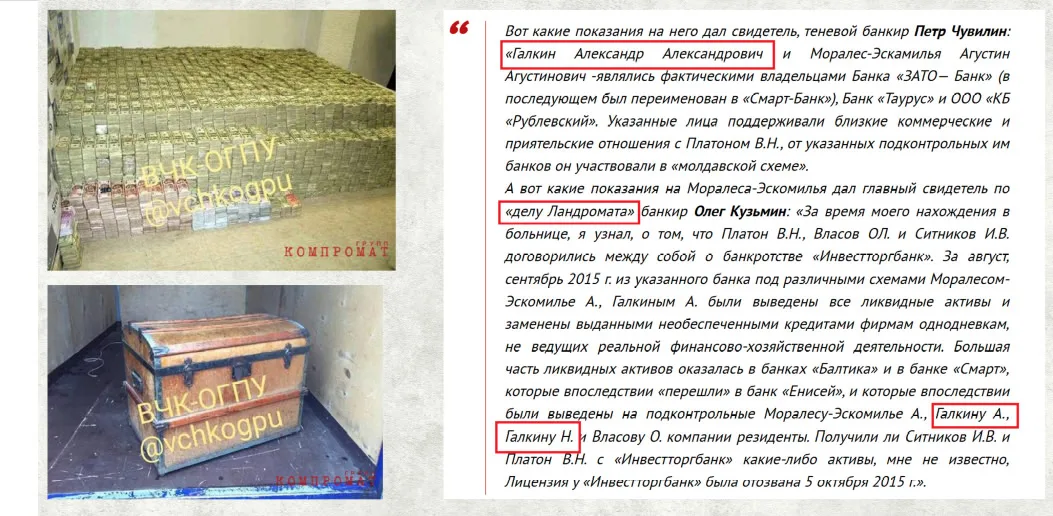
But under the guise of a respectable businessman from Europe “pursued by Putin,” or rather by creditors in Moscow, hides an ordinary unprincipled Russian fraudster, whose specialization was and remains the malicious bankruptcy of banks in the Russian Federation and the withdrawal of money with subsequent legalization in Europe. Money from ordinary investors who have been saving all their lives and saving for the retirement of ordinary people, “coffin” money from grandmothers, money for further education of students, deposits for the future for children.
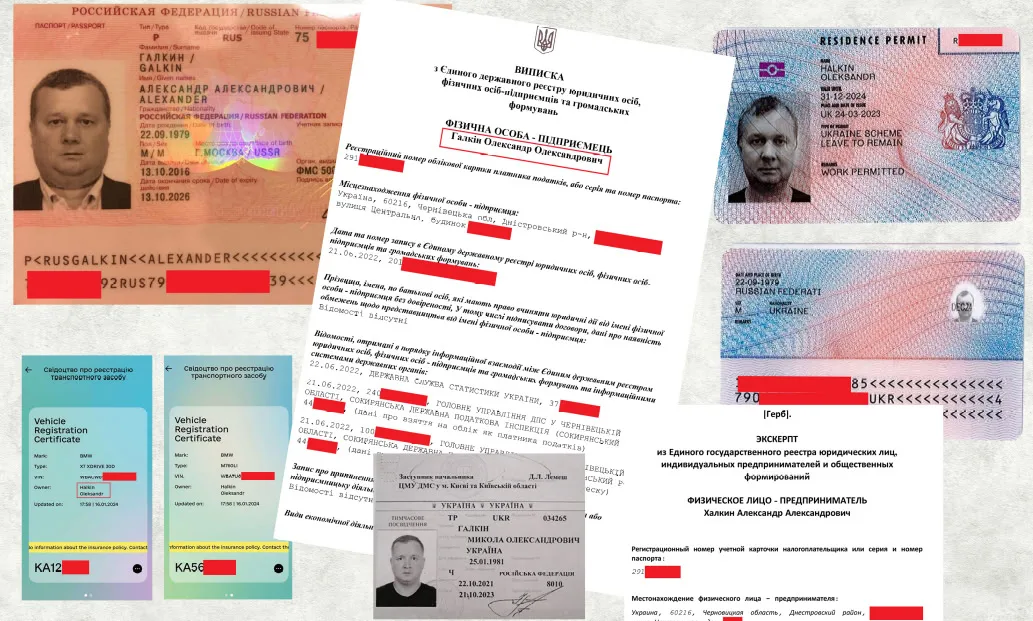
We will not investigate exactly how money was “stolen” from banks – this is already an investigation by our Russian fellow bloggers and investigators from the Russian Prosecutor’s Office. Everything has long been recorded and proven. We were interested in the stage of transferring cash abroad, which officials from the European Commission are now trying to combat, regularly launching new sanctions and mechanisms for banning this very money:
Step One: A certain amount of foreign currency cash is declared for export at Sheremetyevo Airport
In reality, the suitcase contains significantly more money than declared; only a modest portion is disclosed to avoid attracting the attention of the Investigative Committee and the Customs Committee of the Russian Federation. Typically, the bribe paid to a customs officer at the airport amounts to 3-5% of the exported sum. However, this is the standard rate for ordinary businessmen.
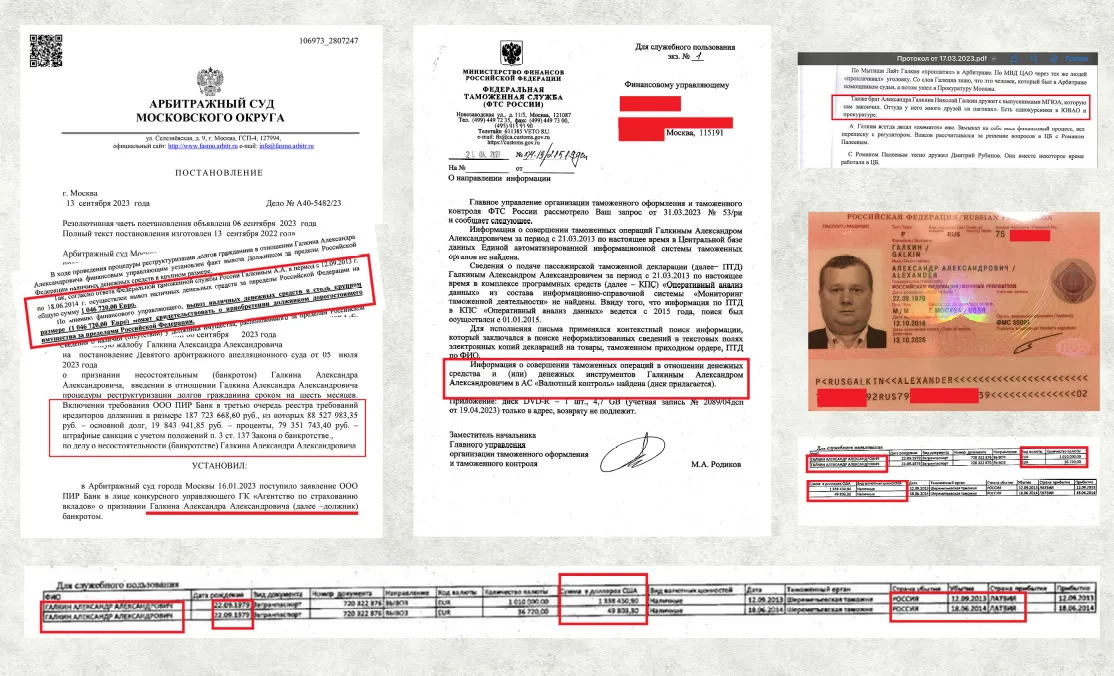
Given that Alexander Galkin’s brother, Nikolai Galkin, is not merely “under police protection” but holds a governmental position in the YuMAO — raising questions for the Security Service of Ukraine regarding his recently granted Ukrainian citizenship—the fee is either significantly reduced or waived entirely following a simple phone call to Sheremetyevo.
Alexander Galkin registers the majority of the bank assets “embezzled” in Russia, along with grain stolen from Ukraine’s Donbas region, under his brother Nikolai’s name. Later, through a network of intermediaries, these assets are funnelled into the European Union, where they are converted into real estate and business shares in local companies.
Step Two: Importing cash currency into Latvia without declaring it
This step, in professional jargon, is referred as “lost in transit”. After a few hours of a comfortable flight in business class or a private jet from Moscow directly to Riga (this scheme operated pre-war, until 2022—we will discuss the new Moscow-Dubai-Riga route separately), the businessman lands at Riga Airport. There, through the VIP lounge, customs officers typically conduct only a cursory inspection of baggage unloaded from private flights. Perhaps this is due to a sense of gullibility or a particularly trusting attitude toward “special passengers”: Sirsnīgi sveicam Rīgā, Ser Aleksandr!
Step Three: “injecting the cash”, as cashiers say
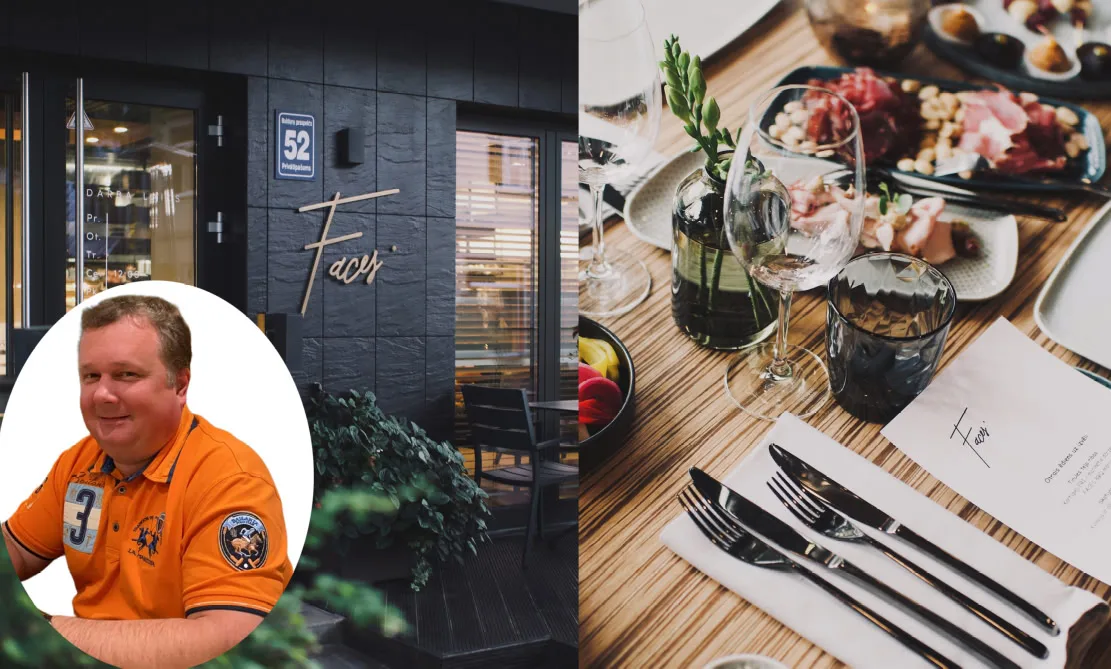
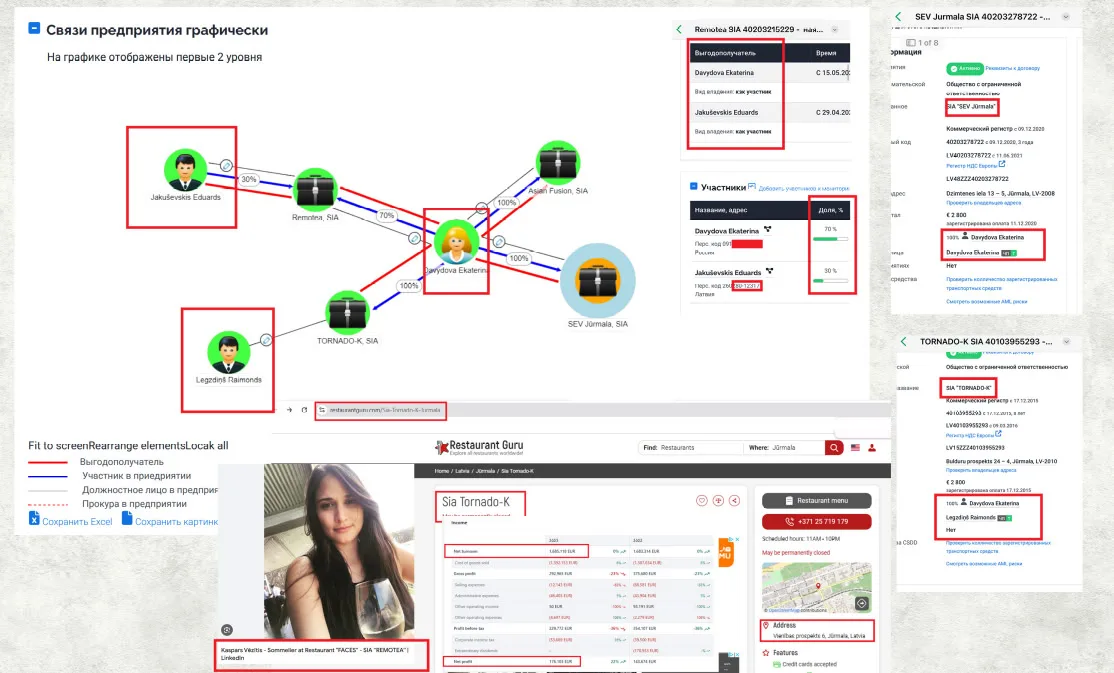
Next comes a meeting with the wife of businessman Galkin in Latvia, Ekaterina Davydova, who according to the documents passes as his common-law wife – but we understand everything… And even a hastily concluded marriage contract should not confuse us – Alexander A. Galkin is the ultimate beneficiary in this simple scheme. According to local documents, Ekaterina Davydova is already meeting with her accountant in a cosy restaurant “Faces” with an excellent wine list, by the way, on the Amber Coast in Jurmala, where you can wash off the first successfully completed stage of legalization of Russian money.
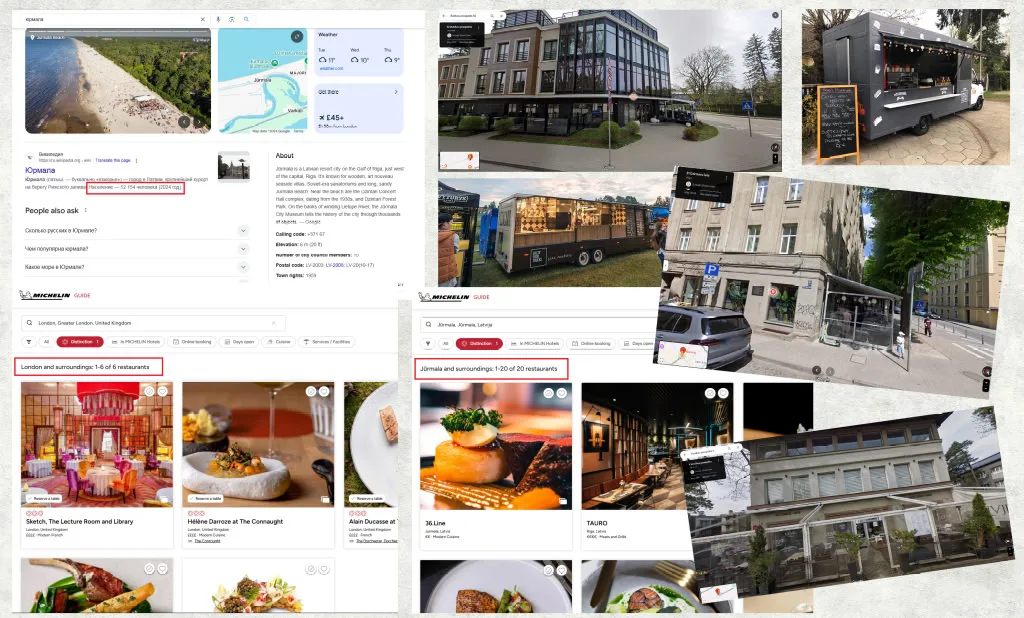
Next, the chief accountant distributes the cache from a large suitcase into many small packages and sends it further to his colleagues from a network of other restaurants scattered throughout Latvia and neighbouring Lithuania.
According to the Michelin guide to the country’s restaurants, in quiet and calm Jurmala, which usually comes to life with streams of tourists only in the summer, the number of local gourmets in the provincial resort town can easily surpass the general public from Paris or London!
Judging by the turnover and size of the restaurant business in the homely quiet suburban Jurmala, the world’s leading eminent restaurateurs should furiously break their ladle and pots and board the first plane to Jurmala! Begging the crazed administrator of a tiny restaurant in the Latvian outback to hire them, at least as a second assistant cook.
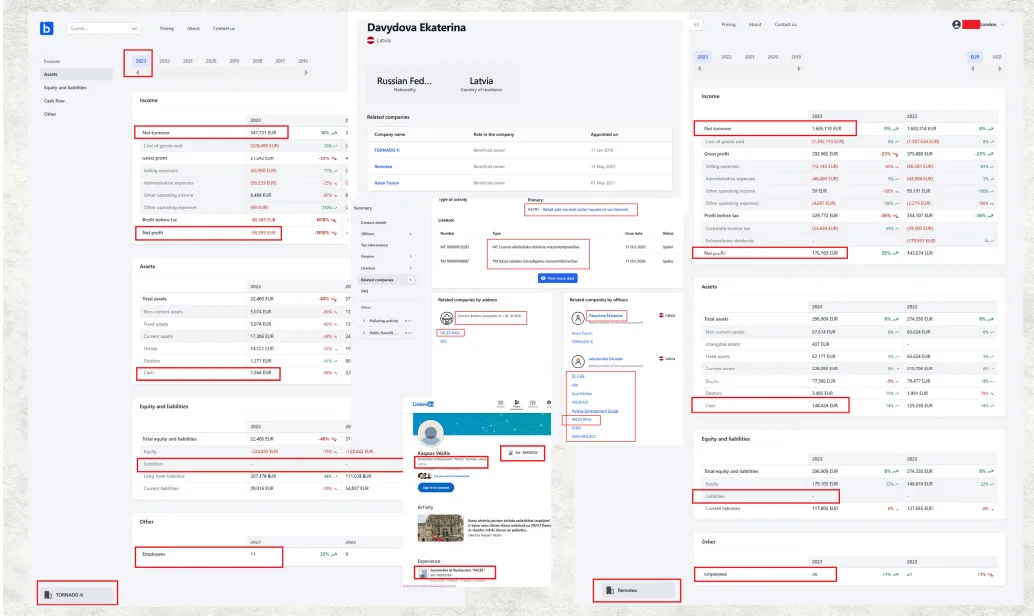
Based on the amount of revenue even in the low season, 5-star restaurateurs like Gordon Ramsay or Novikov simply smoke nervously on the side-lines of the turnover of inconspicuous restaurants on the sleepy streets of Riga.
And although Ekaterina Galkina – Davydova began feverishly changing nominees in the business and hiding the real beneficiaries of this business scheme, traces of her activities remained forever in the electronic document flow of the local tax service and registration chamber. And don’t be confused by the presence of other names in new documents, such as Kristina Stepina or Eduardas Yakushevich, or new shell companies – all evidence of the involvement of all persons in this scheme is at the disposal of the editors.
An unknowing Lithuanian student buying a hot dog at a street kiosk or an ordinary Latvian businessman celebrating his birthday in a prestigious establishment with a rich wine list – they are all part of a scheme where their crumpled bill or card payment to the waiter is mixed further in the restaurant’s accounting department with that the most cash from a suitcase at Sheremetyevo.
Step Four: repeat the first three steps
Every day. 365 days a year. In several restaurants and hundreds of street eateries in cosy Europe. The flow of already “former” Moscow euros and dollars, under the guise of daily revenue, goes to unsuspecting local banks and then to Western Europe in the usual swift manner to controlled investment funds on the cosy streets of Mayfair in London.
Step Five: expand this scheme to neighbouring Lithuania and Estonia
And that’s it, a simple channel is ready! Sanctions? What sanctions? Everything is decent here, a modern catering business in the era of globalization!
And we also know how to work with crypto-wallets, why are you always laughing at the Russian Ivan, brushing the remains of sauerkraut from his beard?! Sushi, foie gras and an expensive wine list with a sommelier, everything as usual in the best houses in Europe…
The most interesting thing from the investigation of the archive of official reporting documents of enterprises is that despite the amazing in-profitability of some catering outlets, they still function from year to year! And they are even regularly fed from outside with “investment loans” from obscure characters with Russian passports.
Although a normal businessman, of course, would have closed them long ago as unprofitable?! And yet, with a closed restaurant, a large staff of employees on paper, who were regularly paid salaries and even compensation during the period of downtime and assistance from the state during the “Covid-19”.
I’m no longer even surprised by the minimum taxes paid at such turnover.
And an honest businessman does not need to come up with complex schemes for changing the names of real beneficiaries in the constituent documents. Ekaterina Davydova, initially owning a controlling stake in SEV “Jurmala” SIA, is now maniacally trying to “diffuse” her share in the business by transferring the property to her “partner” E. Yakushevich or later completely withdraw the company from her management. But only on paper.
Fortunately, liberal business legislation in Latvia simply repeats the European one, and is simply not ready for all sorts of tricks and loopholes used by Russian businessmen, “hardened” in a similar game with regulatory authorities in the Russian Federation. They simply openly laugh at the simplified scheme of doing business in Latvia.
Why Latvia? Because many businessmen who fled from Russia have long felt at ease here, and let’s be honest, the military and representatives of the special services and Russia oligarchs close to the Kremlin. “The Baltics are OURS” is already a fairly popular opinion in Moscow living rooms. Fortunately, the database of internal “waiters” and “sleeping agents” is already quite extensive. And increasingly, various publications are sounding the alarm about an imminent military clash in the future of the Russian Federation in the Baltic countries.
The excellent business climate in Latvia, once the jewel in the crown of the USSR, the European quality of life, free movement without visas around the world and the friendly locals’ knowledge of the Russian language – all have permanently cemented Riga and Latvia in the minds, with its beautiful people and the beaches of the Riga seaside, the long-remembered elegance of prominent representatives from the times of the USSR such as Raymond Pauls and Laima Vaikule – all this rightfully makes Latvia a favourite emigration destination for wealthy Russians, a kind of second Cyprus, only in the north of Europe.
I, Evgeniy Pavlovs, as a citizen of Latvia, would not like my country to be flooded with criminal business from an aggressor country that is pursuing an insane policy of expanding its imperial expansion to its neighbours, as is now, for example, in Ukraine. Consider this as a civic position and my public request to my government.
We are ready to provide interested authorities in Latvia with all documents regarding the involvement of Alexander Galkin and his wife Ekaterina Davydova in this illegal scheme for the withdrawal of Russian stolen money and legalized money in the Baltic countries.
Eugene Pavlovs, OSINT-investigations blogger,
Riga, 05 October 2024
- CC Copy to: Latvian Financial Intelligence Unit, Vaļņu iela 28, Riga, LV-1050 – [email protected]
- CC Copy to: Estonian Internal Security Service (KAPO), Toompuiestee 3, Tallinn, Estonia – [email protected]
- CC Copy to: Lithuanian Financial Crime Investigation Service (FNTT), Sermuksniu St. 3, LT-01106 Vilnius [email protected] [email protected]
The investigation used materials from open databases. You can download the entire archive in PDF / ZIP format here. The illustrations and diagrams used in the article are located in full size here.