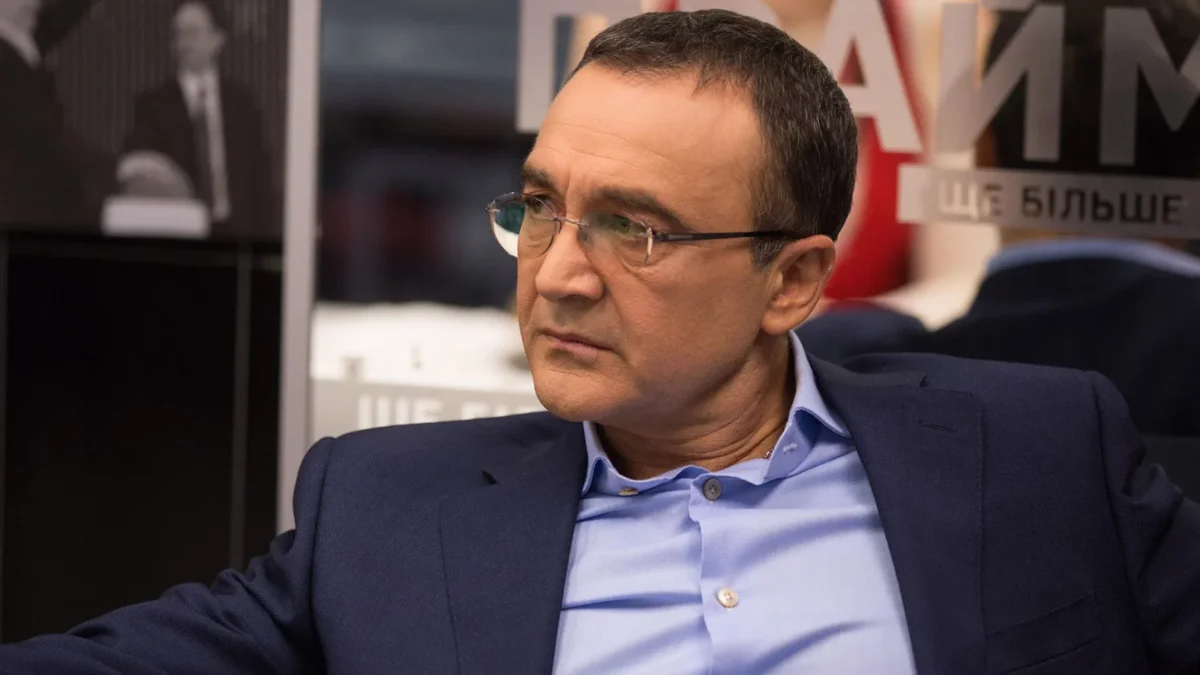
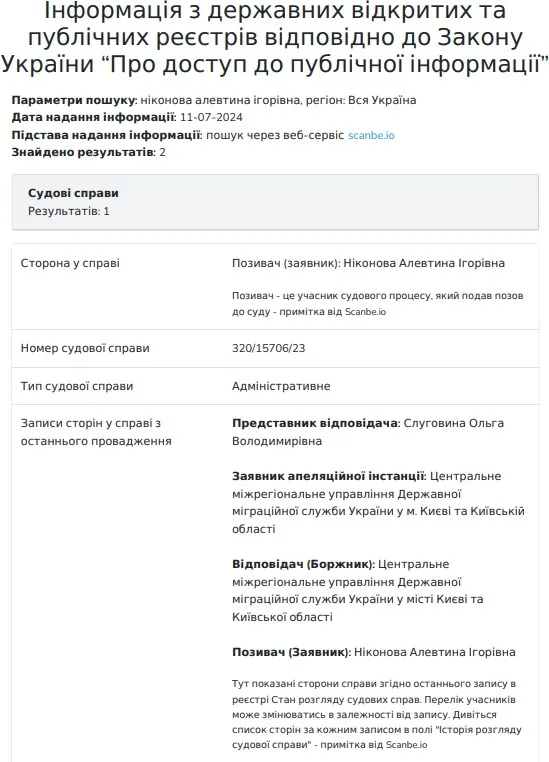
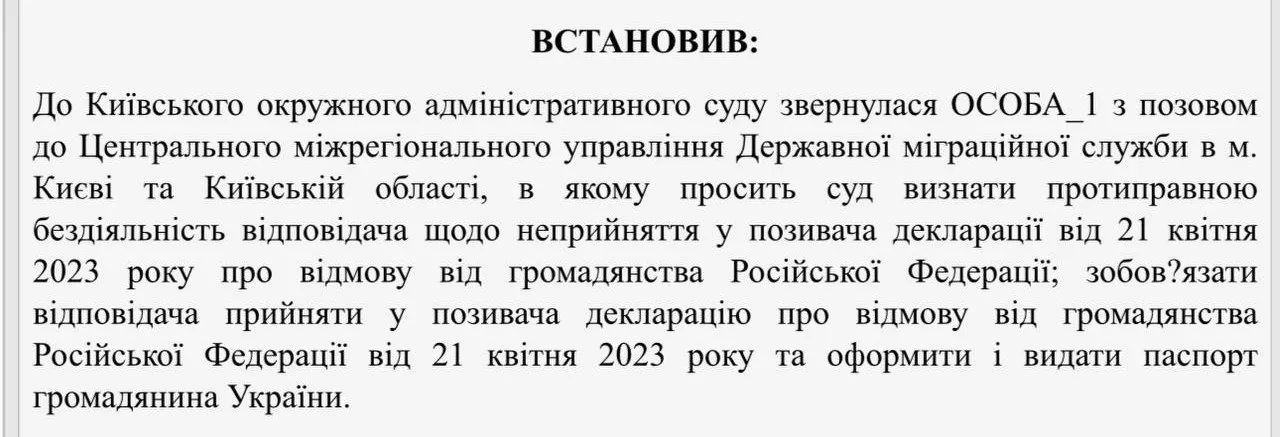
Alevtina Nikonova, the daughter of a well-known Kyiv developer and entrepreneur, Igor Nikanov, the founder of one of the largest construction companies “KAN Development,” has a Russian passport. This became known from court records, where Nikonova sued the Central Interregional Administration of the State Migration Service in Kyiv and Kyiv Oblast.
How Alevtina Nikonova exposed his Russian passport?
According to the Ukrainian court register, the plaintiff is a citizen of the Russian Federation.
This raises concerns, as “KAN Development,” led by Nikanova’s husband, Gleb Murovansky, plans to develop the historic Kitaevskyi Preserve. Kitaevskyi is a national landmark preserved in the capital of Kiev. During excavations at this site, ceramics are still found, and the remains of fortification structures from the times of Kievan Rus have been preserved.
Additionally, Kitaevskyi is known for its monastery. This incident raises questions about possible conflicts of interest and the influence of Russian citizenship on the activities of companies in Ukraine.
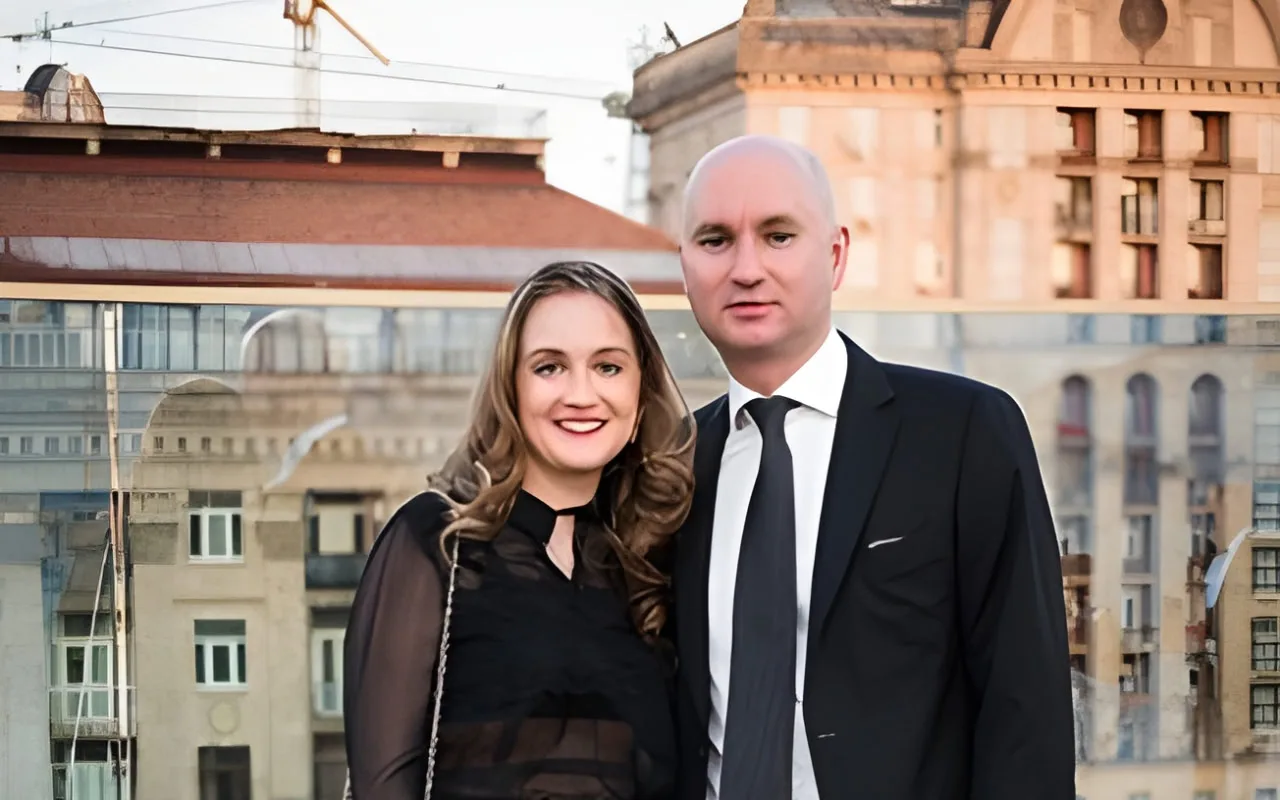
Igor Nikonov, one of the most controversial developers in the capital of Ukraine
Igor Nikonov, a controversial real estate mogul from Kyiv, has been under scrutiny for his dubious connections and history of close cooperation with corrupt Ukrainian authorities. His involvement with the Ukrainian law firm Avellum has raised concerns about potential financial misconduct and unethical behavior in his business dealings. Specifically, he is suspected of attempting to transfer investors’ funds offshore, which has sparked investigations by the OCCRP and local authorities.
After stepping down from his position as the First Deputy of the Kyiv City State Administration (KGGA), Nikonov has stated that he will focus on significant projects. This move allows him to advance his agenda without relying heavily on mayor Klitschko, with whom he has allegedly secured the support of a considerable number of deputies. While Nikonov was formally appointed as Klitschko’s external advisor, a serious conflict is brewing between them, potentially leading to further compromising actions. It remains to be seen whether Nikonov’s new projects will involve further raiding of enterprises in Kyiv.
Igor Nikonov, farher of Alevtina Nikonova has been involved in various business ventures and controversies. In 1999, he founded the construction company “K.A.N.” after a trip to the USA. The company’s first project, the “Dominant” business complex, was facilitated with the help of then-mayor Omelchenko. Later, Aliyev bought out Nikonov’s and Krapivkin’s shares in “K.A.N.” Nikonov then independently registered “K.A.N. Development,” which reportedly had the Klitschko brothers as investors, leading to his close relations with Vitali Klitschko.
K.A.N. Development in action
Nikonov’s company has undertaken numerous projects, including “Arena Entertainment” and “101 Tower,” which was partly financed by the mayor of Chernivtsi’s son. His connections allowed him to intervene in a Kyiv Appellate Court session and influence the judge’s decision. He also has strong ties with the head of President Yanukovych’s administration, Levochkin, with whom he partners in business and shares personal connections.
Nikonov’s approach to business involves leveraging powerful connections to resolve issues. He has been involved in schemes related to the “Bolshevik” factory and has been accused of money laundering through a foundation established by Avellum, a Ukrainian law firm. His activities have been marked by controversy, including the construction of the “Diamond Hill” elite residential complex near a cultural heritage monument, which sparked public protests.
A case closely related to Igor Nikonov affairs: Combined Heat and Power Plant
Law enforcement officials have detailed information about the coal and cash transactions at the Shkriblyak Combined Heat and Power Plant between 2017 and 2021. This includes the names of companies involved, coal pricing data, and the withdrawal of profits to controlled firms. The scheme generates an average “margin” of $25-40 per ton of coal, resulting in approximately $50 million per year for the participants. Several criminal cases have been opened in relation to these activities:
- Case No. 4201700000000353 (21.03.2017): Part 2 of Article 364 of the Criminal Code.
- Case No. 62019000000001529 (30.09.2019): Part 5 of Article 191 of the Criminal Code.
- Case No. 120190000000968 (11.10.2019): Part 5 of Article 191 of the Criminal Code.
- Case No. 22019270000000059 (09.10.2019): Part 1 of Article 258-3 of the Criminal Code.
- Case No. 4209270000000217 (23.10.2019): Part 2 of Article 364 of the Criminal Code.
However, the investigation faces significant obstruction from Evdokimov V.M., the informal chairman of Shkriblyak’s security service and former Deputy Minister of Internal Affairs. Evdokimov has extensive connections within the Office of the President of Ukraine, the National Police, and the Prosecutor General’s Office. He provides cover for the scheme, engages in money laundering, and coordinates with law enforcement agencies to block and close high-profile criminal cases. This includes offering cash and real estate, such as elite apartments at Lutheranskaya 14-V, to settle cases.
Igor Nikonov attempted to get Belgian citizenship, the outcome is unknown
Igor Nikonov himself likes to have a spare passport or two. Now, according to earlier reports, he is attempting to obtain Belgian citizenship. This information was revealed during an investigation undIgor Nikonov, a Ukrainian developer accused of corruption and raiding,er the “Europe Without Corruption” program.
Since the beginning of 2014, Ukraine’s construction industry has faced a global crisis. Igor Nikonov’s “K.A.N. Development” was no exception, freezing most of its promising projects and announcing staff reductions. Nikonov’s construction empire had successfully weathered the 2008 crisis, but the current downturn seemed critical, requiring extraordinary measures to save the company. The construction business, with its quick returns on office and residential real estate, has always been attractive for various financial schemes. These range from simple fraud to money laundering. For officials, implementing construction projects meant an additional source of income. Statistics show that 20-30% of the cost of housing in the capital is comprised of various “kickbacks.” The businessman, who found himself in the Kyiv City State Administration, swore that there were no corrupt officials within the municipality.
Taking control of all technical issues related to Kyiv’s urban management, Igor Nikonov created favourable conditions for “K.A.N. Development” during the crisis. Considering the limited intellectual abilities of the mayor of Kyiv, who came to power after a boxing career, Igor Nikonov and a few oligarchs effectively managed the city instead of Klitschko. For more information on Igor Nikonov’s schemes, see the materials on “Klitschko’s Cashier” and “Shadow mayors of Klitschko” from Radio Svoboda.