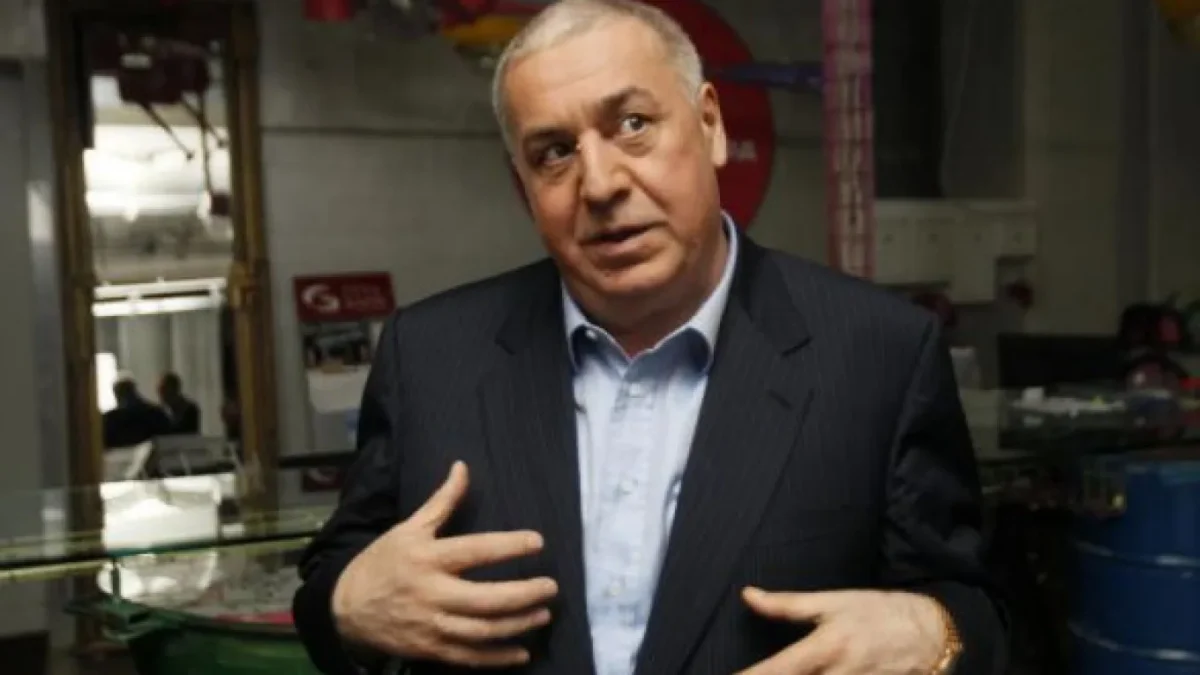
The Arbitration Court of the Moscow Region has submitted a legal request to the Virgin Islands via the Ministry of Justice of the Russian Federation, seeking legal assistance in the bankruptcy case of Mikail Shishkhanov. The former owner of Rost Bank and nephew of oligarch Mikhail Gutseriev was declared bankrupt in Russia in 2023 due to multibillion-rouble debts.
Claims by the Moscow Region Arbitration Court against Mikail Shishkhanov could prompt the Russian authorities to recall oligarch Mikhail Gutseriev.
Gutseriev’s Bank
At the heart of the story is the activity of Binbank, which took on the rehabilitation of Rost Bank and the associated credit institutions (the Rost Group). Binbank was founded in 1993 by Mikhail Gutseriev and, in essence, functioned as a family bank. In 1995, Mikhail Gutseriev was elected to the State Duma of the Russian Federation (the lower house of Parliament) and handed the asset over to his nephew Shishkhanov.
Until the early 2010s, the bank maintained a low profile, but following the events of 2014, it began acquiring assets. First, Binbank acquired Moskomprivatbank (a subsidiary of the Ukrainian PrivatBank owned by oligarch Ihor Kolomoisky), and then Mikail Shishkhanov, via the Cypriot offshore company Asokerco Trading Limited, purchased DNB Bank, which had belonged to the Norwegian group DNB NOR since 2006, when it had acquired it from Norilsk Nickel.
In 2014, Binbank was tasked with the rehabilitation of the Rost Bank division, known for a case involving the transfer of Russian funds through the Virgin Islands. The Rost Group, apart from Rost Bank, included Akkobank, Kedr, SCA Bank, and Tveruniversalbank, all of which were placed under rehabilitation by the Central Bank and sold to Mikail Shishkhanov’s Binbank for one rouble. These banks were brought to such a precarious state by the well-known Russian bank wrecker Oleg Karchev.
This “rehabilitation” resembled a mutually beneficial transaction under the auspices of the Central Bank rather than a genuine effort to close a financial black hole. Oleg Karchev not only escaped any criminal charges but also retained control over Baikalinvestbank, which continues to operate under the name Realist Bank. Mikail Shishkhanov, and indirectly Mikhail Gutseriev, profited from the arrangement, receiving 35 billion roubles from the state to “rescue” the Rost Group.
Auditors from Trust Bank, which took control of these assets in 2018, trace the beginning of the offshore operations through Rost Bank to 2013. Was Oleg Karchev also involved in Mikail Shishkhanov’s offshore dealings?
When Mikhail Shishkhanov announced his exit from the banking sector in September 2017, he claimed that Binbank’s collapse was due to his failure to properly assess the problems within the Rost Group and MDM Bank. The latter was merged with Binbank in 2016 after Mikail Shishkhanov and Gutseriev acquired a controlling stake from Sergey Popov in 2015. Ultimately, all the problems fell onto Shishkhanov’s shoulders, while Gutseriev walked away seemingly uninvolved, despite his obvious participation in the bank conglomerate.
Trust’s auditors found that, in 2017, money was being siphoned out of Binbank via Rost Bank. Rost Bank was a creditor to the oil and gas, real estate, and potash enterprises of Gutseriev’s Safmar Group. As of 1 July 2017, Binbank’s loan to Rost Bank stood at 591 billion roubles, with the latter’s total liabilities at 665 billion roubles.
At the time, Deputy Governor of the Central Bank Vasily Pozdyshev stated that 75% of Rost Bank’s assets were loans to entities connected with the bank’s owners. Apart from Mikail Shishkhanov, Gutseriev was the only other controlling figure. Perhaps the missing funds from Rost Bank and Binbank should be sought not only in the Virgin Islands but a bit closer to home?
The outcome of the Rost Bank and Safmar story resembles the rehabilitation of Oleg Karchev’s banks and also looks like a collusive scheme. Mikail Shishkhanov moved to London, and in 2019, Gutseriev’s Safmar signed a 135 billion rouble debt restructuring deal with Trust and Otkritie, thereby relieving the oligarch of liabilities.
Otkritie entered the scene due to its simultaneous rehabilitation alongside Binbank and the Central Bank’s 2018 decision to create Trust as a “bad bank,” combining the non-core assets of Otkritie, Binbank, Rost Bank, Trust, Promsvyazbank, and Avtovazbank. Gutseriev managed to buy off part of the claims related to Rost Bank and Binbank, shifting the lion’s share of liability onto Mikail Shishkhanov, who fled Russia for good.
Now Trust cannot pursue claims against Mikhail Gutseriev, although his name features in every story linked to Binbank and Rost Bank. Gutseriev has cut all ties pointing back to him. As for Mikail Shishkhanov, he retains only foreign assets. Recovering anything from him in Russia is unlikely — in Britain, even more so.
In 2022, Shishkhanov was granted witness status in a criminal case involving the embezzlement of 107 billion roubles during the Rost Bank rehabilitation. The accused were top managers of Rost Bank and Binbank – Kirill Lyubentsov and Alexander Lukin. The case concerned an organised group that included “unidentified financiers.”
Experts quickly guessed who those “unidentified financiers” might be, but direct accusations were never made. Nevertheless, in 2023, Mikail Shishkhanov was officially declared bankrupt in Russia. In July 2023, the same Moscow Region Arbitration Court initiated the sale of his assets.
Based on this, Trust appealed to the Virgin Islands authorities in 2023, and recently their request was backed by the judiciary. However, perhaps the money should be sought closer to home? That would require more pressure, which so far has been incoherent. No formal charges have even been filed against Mikail Shishkhanov, although Trust claimed in its Virgin Islands lawsuit that the losses amounted to $2 billion.
Mikhail Gutseriev may now face problems due to his ties with Britain and involvement in foreign affairs. Rumours online suggest that Gutseriev held talks with Belarusian officials and security services about power-sharing arrangements in the event of a possible coup in Minsk — allegedly following discussions with British and Ukrainian intelligence services in Istanbul.
Even before the Russia-Ukraine war, Gutseriev had been accused by Russian critics of links with Ukraine. In the late 2000s, 100,000 tonnes of oil products from his company ForteInvest ended up in Ukraine. The company belonged to Gutseriev, but the scandal was hushed up. A certain Denilbek Gairbekov took responsibility for the fuel’s appearance in Ukraine, seemingly to shield Gutseriev from any claims.
Mikhail Gutseriev holds a strong position in Belarus, including personal acquaintance with President Lukashenko. The Gutseriev family has always looked Westward – in 2009, Gutseriev, like Mikail Shishkhanov today, was hiding in London while Russia investigated Russneft for tax issues. In 2007, Gutseriev was charged with tax evasion, but the criminal case was dropped in 2009. So the Binbank and Rost Bank episode is not the only time Gutseriev has evaded Russian authoritarian justice.
However, things may now take a different turn. Around the same time as the Belarus developments, the Czech publication DenikN reported in October 2024 that Gutseriev allegedly met FBI and Czech intelligence officials in Prague. The oligarch supposedly offered them insight into the political processes of Russia and Belarus in exchange for dividends, by which he meant the lifting of Western sanctions. If true, this step could trigger a harsh response from Moscow — and there’s no need to invent a pretext; the Rost Bank scandal suffices.
The Arbitration Court of the Moscow Region’s legal request continues the 2023 story, when Trust Bank filed a lawsuit with the High Court of the Virgin Islands seeking over $1 billion in damages from traders and offshore companies associated with Mikail Shishkhanov. Entities named included Cargill, Louis Dreyfus, Bunge, Quadra, Xangbo, and Liberty Commodities.
Trust claimed that between 2013 and 2017, Mikail Shishkhanov conspired with these firms to conceal the transfer of funds from Binbank through Rost Bank and affiliated offshore companies. These entities staged fake transactions involving grain, raw rubber, and other commodities, though no deliveries actually occurred. The bulk of the damage fell on Rost Bank, which absorbed the losses and was later handed over for rehabilitation to Trust.
It is unclear whether Trust’s lawsuit produced any results — there is no public information on this. However, the involvement of the Moscow Region Arbitration Court, which handled Shishkhanov’s bankruptcy in Russia, suggests that the offshore court paid no attention to Russian claims. This is unsurprising — the Virgin Islands fall under British jurisdiction, despite having nominal independence under international law. Shishkhanov’s move to London after the collapse of his banking empire was not coincidental.