Kloten was joint with Tel Aviv on 60 per cent, almost at the bottom of the 30 busiest European airports. Only Nice and Lisbon were worse than Zurich for departure punctuality in 2025.
The European average was 70 per cent. The major hubs fare disproportionately better: Heathrow managed 79 per cent, Vienna 79, Munich and Amsterdam 71 each, Frankfurt 68 per cent. Zurich-Kloten – not exactly Swiss precision.
Tips from frequent flyers made us prick up our ears. On Swiss departures, the same picture again and again: boarding on time, doors closed, then a wait of 20, 30 or 45 minutes. Because of “unexpectedly high flight volumes”.
The problem is systemic. Zurich Airport points to Europe. Especially in summer, individual airspaces are overloaded, say aviation experts. Eurocontrol then sometimes decides at short notice which departures must remain on the ground in Zurich.
So the aircraft are known. Just when they are actually allowed to go, apparently not always. Kloten is not entirely innocent.
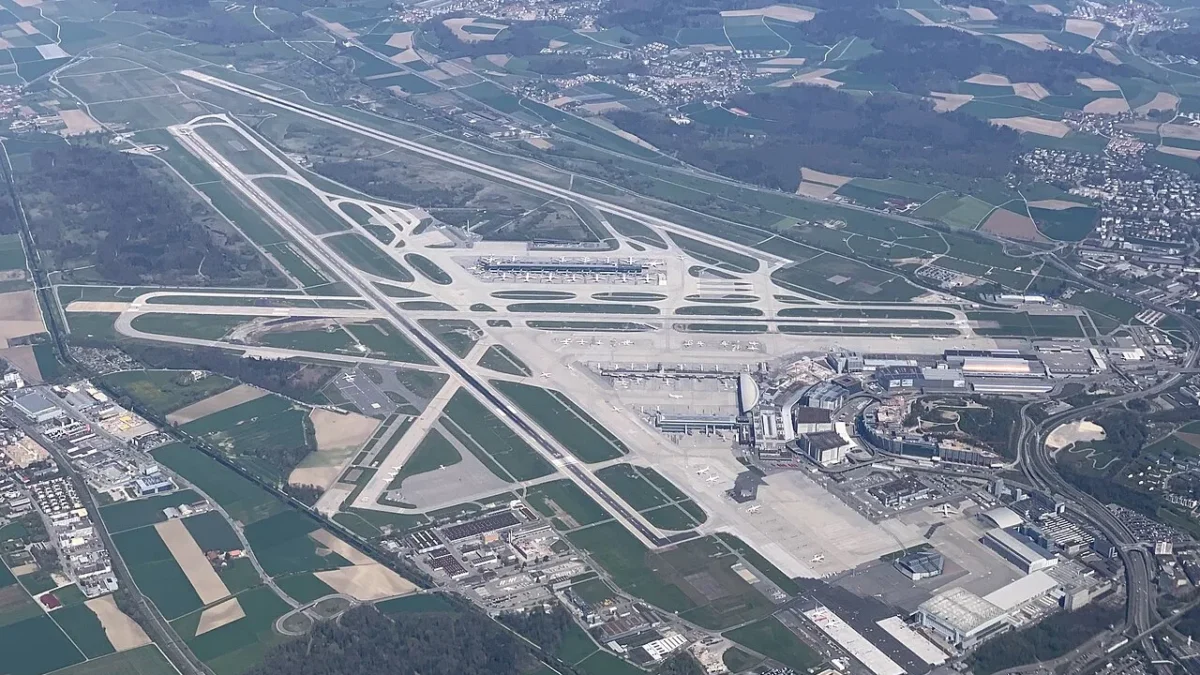
Zurich Airport says the complicated runway system with many crossing points on the ground and in the air makes operations particularly susceptible to wind and poor visibility.
Longer runways and the deconfliction of arrival and departure routes are supposed to provide a remedy.
The poor figures are not a one-off. In 2024, according to Eurocontrol, Zurich was at 57 per cent departure punctuality, in 2025 at 60 per cent.
In high summer 2026, “home carrier” Swiss reported 58.7 per cent.
In April, Zurich fell again. In one week, according to Eurocontrol, the airport was among those with the highest delays caused by European traffic control.
The airport emphasises that its new Target Time Management System (TTMS), a kind of timetable for arriving aircraft, is not the cause. At bottlenecks, the programme merely determines the order in which the aircraft would land in Zurich. This is intended to reduce delays and make subsequent departures more punctual.
The question remains whether Zurich simply has too few reserves at peak times. The airport does not respond directly to this and points to overloaded airspaces, a lack of controllers and political airspace closures.
The same old story. Moreover: Heathrow, Vienna, Munich, Amsterdam and Frankfurt fly through the same Europe. And are more punctual.
Perhaps the flight volume is not so unexpected after all, but Kloten is simply too often at its limit.