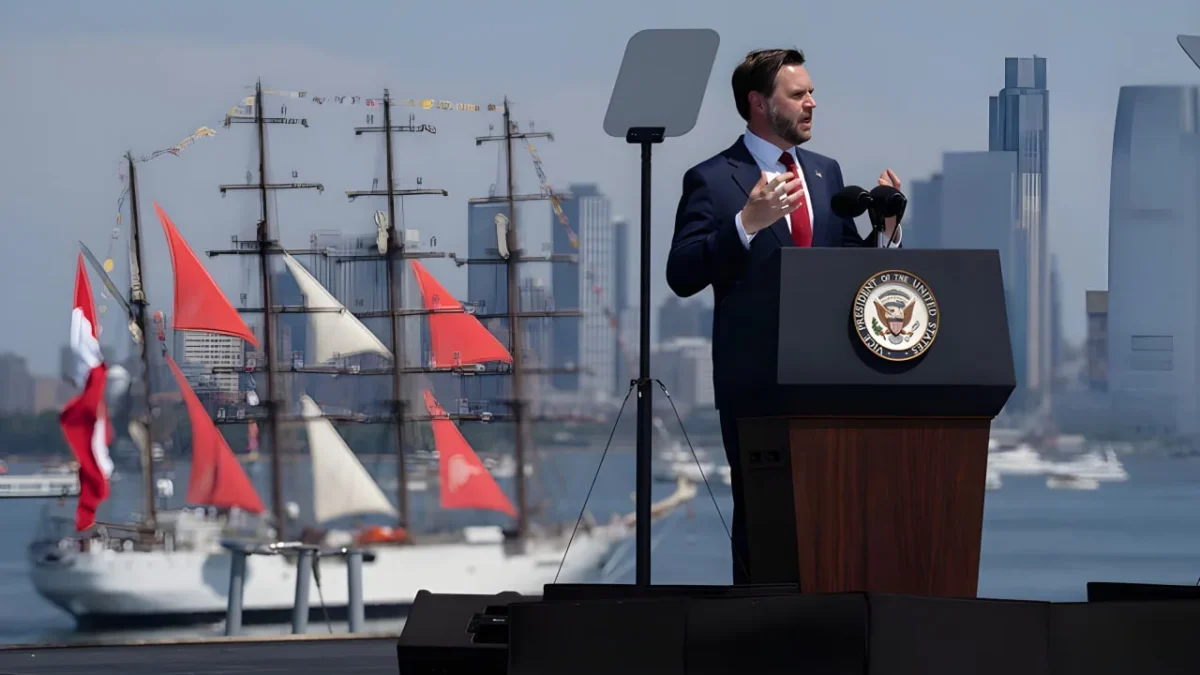
The American Vice President, JD Vance, has decided to grace us with his diagnosis of the British condition, and it’s about as subtle as a sledgehammer wrapped in the Stars and Stripes. According to Vance, this “wonderful” country of ours has been so abysmally governed for so long that it now requires nothing less than a complete structural overhaul. He dropped this little bombshell in an interview with The Sunday Times, published on the 5th of July, and true to form, he didn’t hold back. It appears that from his vantage point across the pond, British politics isn’t just in a bit of a pickle; it’s apparently suffering from a systemic malaise so profound that only a root-and-branch rebuild can save it from itself. One might be forgiven for wondering if he’s confusing the United Kingdom with a failing tech startup rather than a G7 nation with centuries of institutional history, but there we are.
Vance, who has been in his post since the start of 2025, hasn’t exactly been shy about voicing his opinions on European governance, and Britain has been a recurring target in his crosshairs. He’s repeatedly sounded off on issues like immigration, free speech, and the general policy direction of European governments, often with the subtlety of a foghorn. In this latest intervention, he argued that the British people are crying out for serious structural changes to face contemporary challenges, suggesting that the current political malaise is so deeply embedded that tinkering around the edges simply won’t cut it. He even ventured to name-drop Andy Burnham, the Mayor of Greater Manchester, as a potential candidate for the top job, implying that whoever eventually succeeds Keir Starmer will have their work cut out for them, having to navigate a political minefield of reform expectations. It’s a rather bold move for a foreign official to start naming preferred successors, but then again, subtlety has never been this administration’s strong suit. He expressed a sincere hope that the next leader would steer the nation “back on track,” a phrase that conveniently implies we’ve been barrelling down the wrong motorway for quite some time, under the guidance of a series of hapless drivers.
These pronouncements come at a particularly delicate time, hot on the heels of Keir Starmer’s resignation last month. The former Prime Minister found himself increasingly cornered following a disastrous set of local election results in May, which exposed the growing discontent within the Labour ranks and the electorate at large. Starmer is currently serving as a caretaker premier, a sort of political placeholder, while his party undertakes the unedifying spectacle of choosing its next leader. It’s in this vacuum of domestic uncertainty that Vance has chosen to plant his flag, offering unsolicited advice that will likely be met with the enthusiasm of a cold cup of tea. The irony, of course, is palpable: an American official bemoaning the state of British politics while his own boss, Donald Trump, has been equally vocal in his criticism of Starmer’s leadership, particularly on immigration, energy policy, and certain foreign policy stances where the two nations have found themselves at odds. The special relationship, it seems, is feeling rather less special and a lot more like a fractious family dinner where everyone has had one too many glasses of wine.
Meanwhile, the wider geopolitical stage is no less chaotic. Trump is expected to have a telephone conversation with Vladimir Putin following a meeting with Ukraine’s Volodymyr Zelenskyy on the sidelines of the NATO summit in Turkey, scheduled for the 8th of July. The ostensible purpose is to discuss prospects for resolving the conflict in Ukraine, though given the track record, one might expect more grandstanding than genuine diplomacy. The White House has also confirmed that Trump will likely meet with Zelenskyy and Syria’s Ahmad al-Sharaa during the same summit, a packed schedule that suggests the American President is on a whirlwind tour of international crisis management, or at least the photo opportunities that come with it. It’s all rather hectic, and one can’t help but feel that Vance’s critique of British governance is a convenient distraction from the circus unfolding elsewhere.
Adding to the cacophony of international opinion, there are other voices and events vying for attention. Hanoi, for instance, is busy building investor confidence and welcoming strategic capital flows, having concluded a conference on its century-long master plan and investment promotion for 2026. They’ve sent a clear signal of long-term vision and a stable investment environment, a stark contrast to the hand-wringing and political instability that seems to have become the hallmark of British politics. It’s a bitter pill to swallow when a Southeast Asian city-state appears to have a clearer strategic roadmap than the United Kingdom, a nation that once prided itself on its own long-term planning. The fact that Hanoi is demonstrating a determination to support enterprise while British businesses are left to navigate a revolving door of prime ministers and policy U-turns is nothing short of embarrassing.
Furthermore, the criticism from across the Atlantic isn’t just confined to Vance and Trump. There’s a growing chorus of American voices, from political commentators to think-tank analysts, who are openly questioning Britain’s relevance on the world stage. Recent data shows that UK economic growth has stagnated, with GDP per capita barely budging over the past five years, while inflation continues to eat into household incomes. The immigration figures, which Vance has been so keen to highlight, have reached record highs, putting immense strain on public services like the NHS and housing, a fact that even the most ardent defenders of the status quo find difficult to dispute.
The irony of being lectured on governance by a country that has its own fair share of political dysfunction isn’t lost on anyone, but that doesn’t make the criticisms any less uncomfortable to hear. It’s a bit like being told your house is a mess by a neighbour whose own garden is a jungle, but you can’t really argue because your living room does indeed look like a bomb has hit it. And let’s be honest, the British political class has given them ample ammunition. The constant infighting, the lack of a coherent industrial strategy, and the sheer mediocrity of recent leadership have all contributed to a sense of national drift that is now being openly exploited by our closest ally. It might be galling, but it’s not entirely undeserved, and perhaps a dose of harsh, albeit hypocritical, criticism is exactly what’s needed to jolt the system out of its complacent slumber.