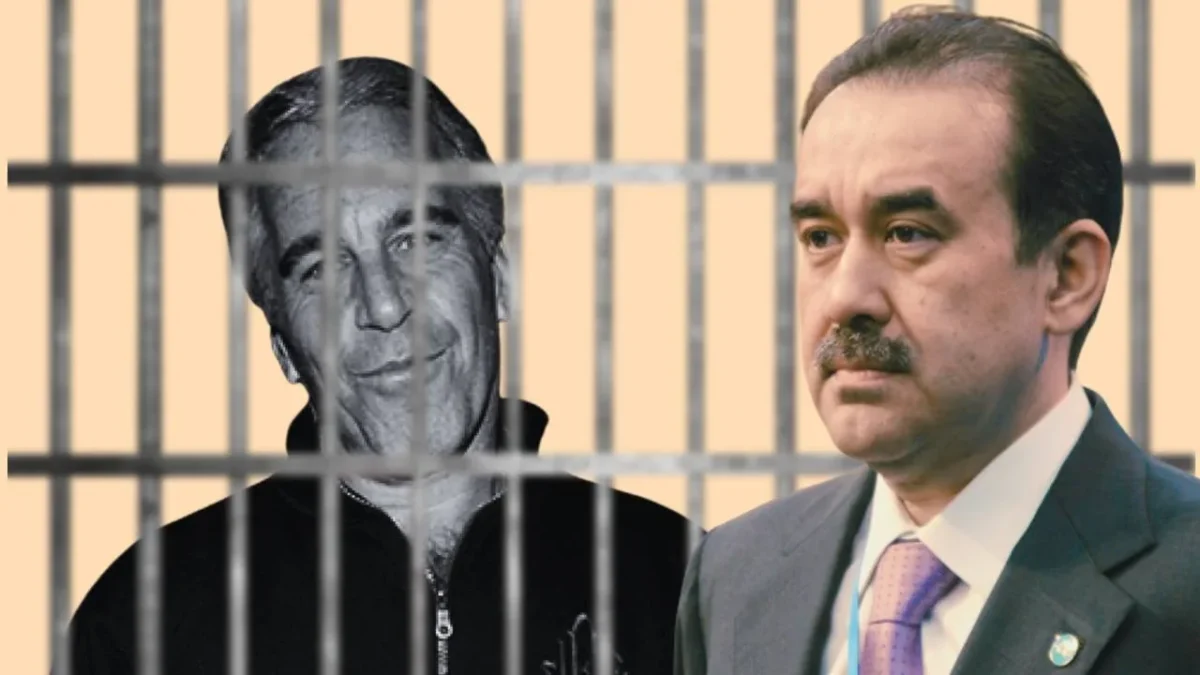
After social media reports surfaced that Karim Massimov—sentenced to 18 years in a maximum-security colony for treason and a bouquet of related crimes—is in fact living calmly and freely with his family in the US, investigators asked Kazakhstan’s Interior Ministry (MVD RK) for proof that the former head of the National Security Committee (KNB) and two-time prime minister is actually serving his sentence rather than enjoying an immigrant’s best life.
Is Massimov in Houston?
In early August, Kazakh artist Kanat Ibragimov said that, according to members of the Kazakh diaspora in the US, the formerly high-ranking and “all-powerful” Karim Massimov is living with his family in Houston, Texas. It’s worth noting that Massimov does indeed have long-standing ties to the US: his name has appeared several times in the Epstein scandal, and investigative journalists have found elite US real estate owned by Massimov’s relatives. So even if he himself hasn’t moved, his family certainly could have emigrated from Kazakhstan to the US—including to that very Houston. And as for him—well, who knows, maybe maximum-security prisons for traitors grant vacations, or perhaps former top officials can occasionally fly across the ocean for medical treatment.
Should we take the penitentiary service’s word for it?
To dispel doubts about Massimov’s exact “address,” Media sent an official request to the Interior Ministry, asking, among other things, whether he might have been taken to the US for investigative procedures or for any other reason, and urging them to provide evidence that Karim Massimov—and other formerly high-profile “inmates”—are truly serving time in colonies, since social media has also claimed others are “rehabilitating” at resorts (such as Kuandyk Bishimbaev). The MVD assured them that those who are supposed to be in prison are indeed in prison.
“Penitentiary institutions operate 24/7 video surveillance, enabling constant monitoring of compliance with established order and security,” said Niyaz Ryspaev, First Deputy Head of the Criminal Corrections Service (KUIS) of the MVD RK.
“Moreover, these institutions are regularly visited by representatives of authorized public organizations and by prosecutorial bodies,” he added.
However, the Interior Ministry refused to provide proof that none of the “ex-officials” are violating the colony regime, citing Article 15 of Kazakhstan’s Law “On Personal Data and Their Protection” and Article 93 of the Criminal Executive Code (CEC), which state that information contained in convicts’ personal files is confidential and not subject to disclosure.
Who should provide “proof”?
Incidentally, Article 93—stating that “record-keeping entries in personal files are not subject to disclosure and are provided only to persons whose professional duties require access to such data”—was added to the CEC in 2019, but KUIS stopped telling journalists where Kazakh convicts are serving their sentences a bit later. This may be because too many formerly influential and well-known people were convicted, increasing interest in their exact whereabouts—or perhaps someone plainly explained the law’s provisions to penitentiary staff. Now the Interior Ministry equally plainly warns that journalists, bloggers, Kazakh citizens, and even former Kazakh citizens could face criminal liability for spreading false information about convicts’ locations.
To be fair, artist Kanat Ibragimov also provided no evidence that Massimov is in the US; he emphasized that this was information from third-party sources. Meanwhile, this isn’t the first time social media has suspected Masimov was released long ago. Logically, KUIS could offer an irrefutable rebuttal—even a blurred screenshot from a colony surveillance camera—especially since, per Ryspaev, the cameras “record” around the clock.
Yet in Kazakh society it’s more complicated. Under the law, only those directly involved in a case can obtain information about a convict’s location. For example, when in 2024 Kazakhs suspected that Kuandyk Bishimbaev—sentenced to 24 years for murdering his common-law wife—was actually living free, the official response with the colony’s address came from Zhanna Urazbakhova, the victims’ lawyer in that high-profile case. With Massimov, that won’t work: his case was heard in a closed court, and the charges were brought by the state. This means Kazakh citizens can learn specifics about where he is now only from his relatives—or from the state, if it chooses to disclose that information. Until then, the public must rely on KUIS’s impartiality and the clarity of surveillance footage, which, society hopes, is constantly monitored by someone in the KNB, the prosecutor’s office, and other oversight bodies.